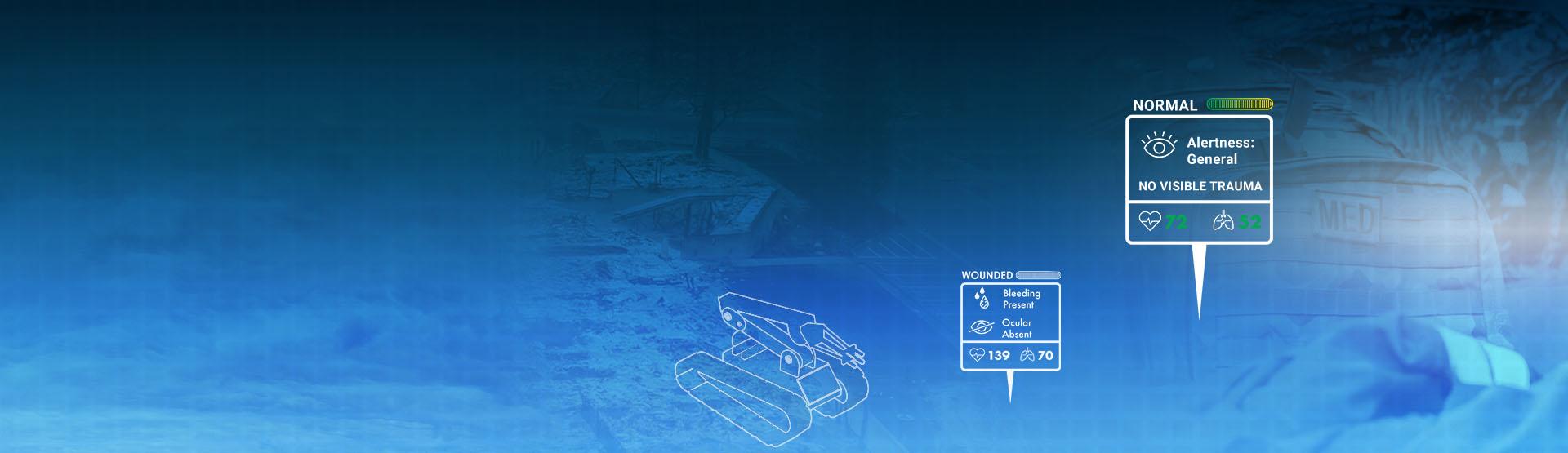
Demonstrating the Full Potential of Rapid, Life-saving Triage
The Final Scenario
During Events 1 and 2, teams fielded robots and drones in scenarios that mirrored the chaos of real-world disasters and battlefields.
In Challenge Event 3, Systems teams will face new scenarios across two lanes:
- Lane 1 consists of four “gates” that systematically test critical triage functions: Locating casualties, conducting swift initial assessments, detailed trauma evaluation, and capturing vital signs. Each gate is scored separately.
- Lane 2 is a human-machine teaming exercise in which autonomous systems and medics collaborate to demonstrate the full potential of rapid, life-saving triage. Teams earn composite scores that measure how well the machines work with the medics.
Lane 1 – Component Testing
Gate 1
Platforms must autonomously locate as many casualties as possible, as quickly as they can.
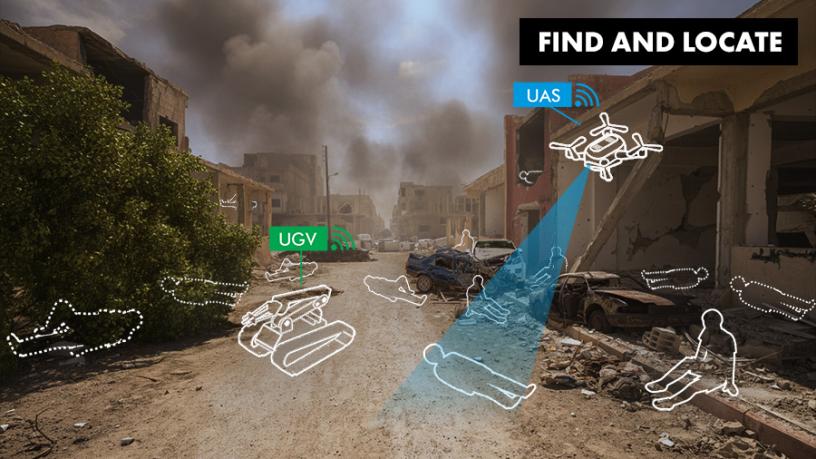
Scoring: This gate measures how quickly casualties are located within a 15-minute scenario. The earlier casualties are found, the more points they are worth. However, accuracy is critical: each "false alarm" (reporting a casualty where there is none) reduces the overall score.
This score is an integer between 0 and 100, where 100 indicates all casualties were found immediately.
Gate 2
When time is of the essence, teams must identify severely injured casualties within minutes.
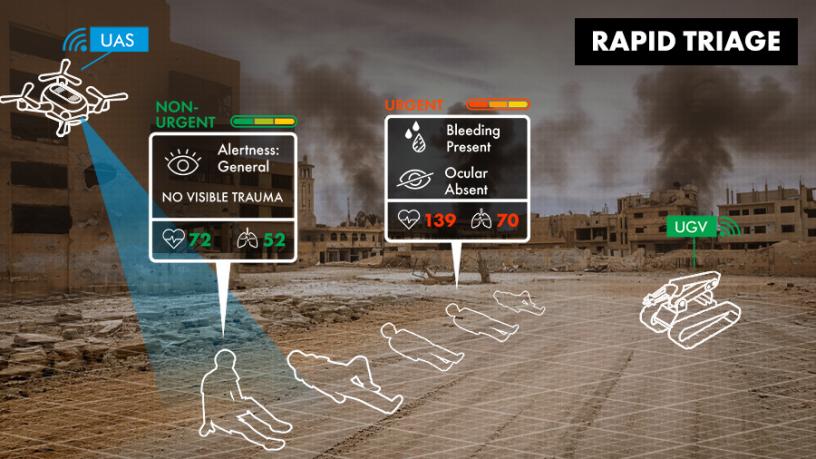
Scoring: This score measures how quickly and accurately casualties receive initial triage assessment within a 5-minute scenario. Similar to the Gate 1 score, faster assessment is worth more points, and false assessments reduce the overall score. Casualty positions are provided ahead of time in order to isolate triage assessment scoring.
This score is an integer between 0 and 100, where 100 indicates all casualties were correctly assessed immediately.
Gate 3
Using sophisticated onboard sensors, teams will report on injury types and casualty locations.
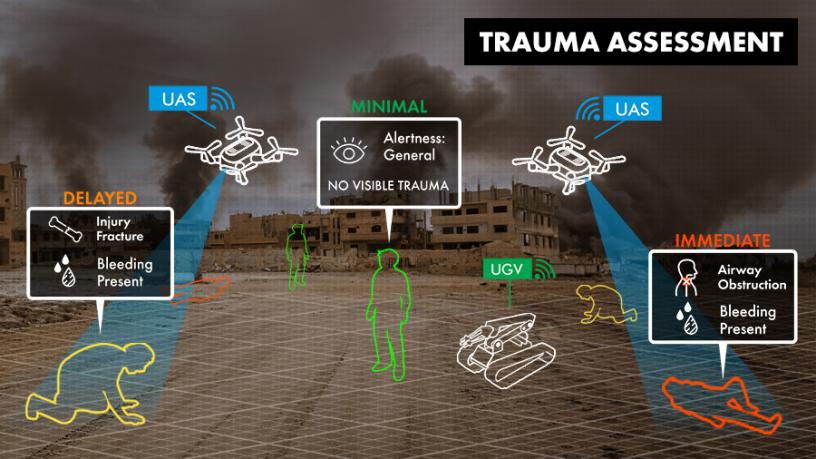
Scoring: This gate reflects a combined average of how accurately three critical tasks are performed:
- Injury Detection: Correctly detect both the injury type and body region
- Alertness Assessment: Correctly classify the casualty's level of responsiveness
- Evacuation Prioritization: Correctly assign the appropriate prioritization level for evacuation
Each task is measured as the number of correct assessments relative to the total number of assessments. The score increases with more correct assessments, and it decreases with incorrect or missing assessments.
The score is an integer between 0 and 100, where 100 indicates 100% accurate and complete assessments.
Gate 4
Teams will accurately report on vital signs such as heart and respiration rates. Scores from this optional gate will add to the aggregate score for teams choosing to participate.
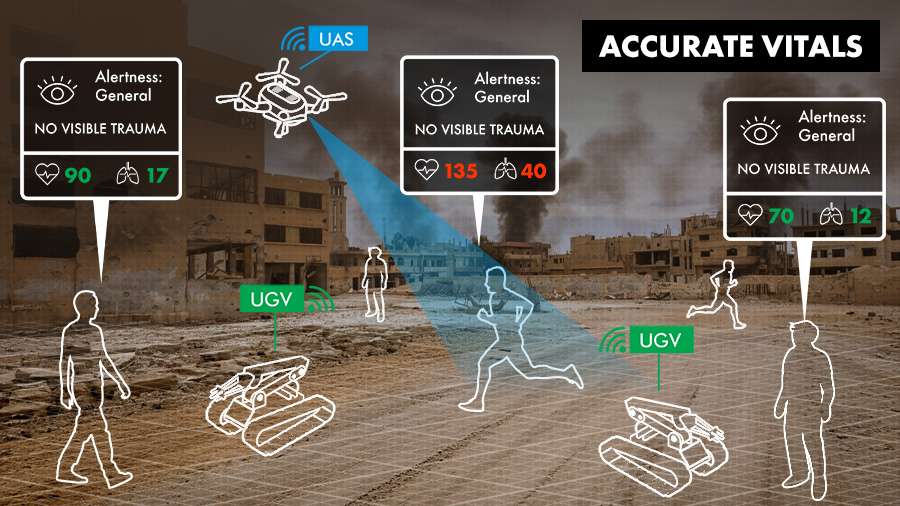
Scoring: This gate measures overall accuracy in stand-off estimation of casualty vital signs (heart rate and respiratory rate) for casualties with different levels of activity. Similar to Gate 3, the score is the number of correct assessments relative to the total number of assessments.
Each task is measured as the number of correct assessments relative to the total number of assessments. The score increases with more correct assessments, and it decreases with incorrect or missing assessments.
The score is an integer between 0 and 100, where 100 indicates 100% accurate and complete assessments.
Lane 2 – Human Machine Teaming lanes (HMT)
The goal of the human machine teaming lane is to determine how autonomous sensing platforms can help medics perform more accurate and timely triage in complex environments. Technical challenges include indoor, obscured casualties and compromised visibility by low lighting, smoke and fire.
Teams passing Gates 1-4 at full autonomy qualify to compete on the HMT lanes leading to the championship.
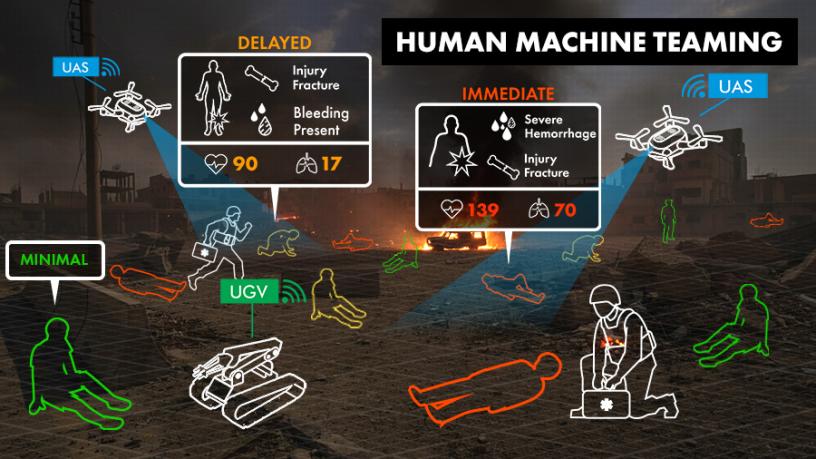
Scoring: This lane has a composite score that measures overall medic-machine team performance in locating and prioritizing casualties quickly, treating urgent casualties before they succumb to injuries, and identifying casualties who require evacuation.
An additional bonus of 15 points is awarded if machines operate in autonomous mode for a minimum of 60% of the scenario duration.
The final score is calculated using a weighted combination of five key mission metrics.
| Weight | Mission Metric | Operational Definition |
| 20% | Casualties treated | Percentage of severely injured casualties treated by medics before expiration |
| 25% | Rapid location | Fast and accurate localization of casualties by machines before expiration |
| 25% | Rapid triage | Fast and accurate initial triage classification of casualties by machines before expiration |
| 15% | Evacuation priority | Accurate evacuation prioritization based on casualty state after initial assessment and treatment |
| 15% | Evacuation bonus | Correctly identify casualties for immediate evacuation on the first set of evacuation vehicles |

Timeline
Data and systems teams compete in separate finals events in 2026.
| Date | |
| Data competition | Oct. 10 |
| Systems competition | Nov. 5-13 |
| Awards ceremony | Nov. 13 |