Can Robots Help Medics Save Lives after Mass Casualties?
2026 Finals
In the final challenge event, teams will face the most complex environments yet.
What is Triage?
When disasters such as earthquakes, major accidents, or attacks occur, there are often far more victims than medical responders.
Triage is the process of quickly assessing patients to determine who needs medical care first. Typically, this involves a handful of medics making rapid decisions in chaotic, dangerous conditions.
Every casualty's life hinges on the speed and accuracy of these decisions.
The DARPA Triage Challenge aims to drive breakthrough innovations that will help medical responders save lives. | 2:18 | More information on DVIDS
Source: DARPA | Spencer Bruttig
Timeline
Finalists compete for up to $1M - 1.5M in awards
in Fall 2026.
| Date | |
| Systems competition | Nov. 5-13 |
| Awards ceremony | Nov. 13 |
News
- Finals preliminary systems competition rules now available
- DART and MSAI triumph in Challenge Event 2
Better, Faster Triage
The DARPA Triage Challenge (DTC) seeks to transform how medical responders triage in mass casualty incidents (MCIs) by developing autonomous systems – such as drones and robots – that can assess injuries quickly, accurately, and at scale.
Through a series of scenarios, competitors must demonstrate that their systems can locate casualties, identify signs of injury, and transmit critical data to medical response teams. These breakthroughs aim to help military and civilian responders prioritize care and save lives when medical resources are stretched.
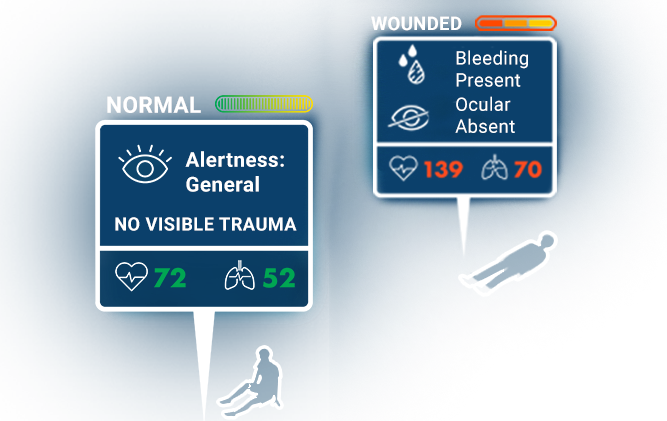
With new technology, autonomous systems can quickly locate and accurately assess victims in a mass casualty incident.
Source: DARPA | Jahyra Catala, Alissa Eckert MSMI
Because Every Minute Matters
Current triage methods can’t always predict who needs life-saving care first. The DARPA Triage Challenge is driving new solutions to close this critical gap and ensure that limited medical resources reach the right patients at the right time.
Competing teams have developed algorithms, unmanned aerial vehicles (UAVs), and/or unmanned ground vehicles (UGVs) designed to collaborate with the human medics who provide hands-on evaluation and care in the field.
What is a DARPA Challenge?
A DARPA challenge is a prize-funded competition sponsored by the agency to accelerate the development of groundbreaking technologies by having teams compete to solve complex technical problems. DARPA challenges are designed to bridge the gap between fundamental research and practical applications for military and national security needs.
| “ |
By deploying remote technologies, we can better ensure that we get the right patients to the right level of care in the right time. – Col. Stacy Shackelford, Trauma Medical Director, Joint Trauma System (JTS)
|
Testing Scenarios
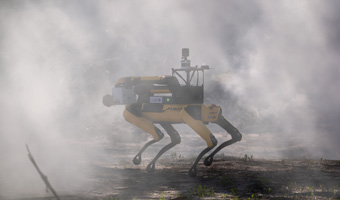
Source: DARPA | Paul Flacks