Breadcrumb

  1. Home
  2. Research
  3. Challenges

Challenges

Challenges

Challenges are designed to accelerate the development of groundbreaking solutions for critical national defense and public safety needs, such as developing autonomous ground vehicles, self-driving cars, robots for dangerous environments, and automated cybersecurity systems.
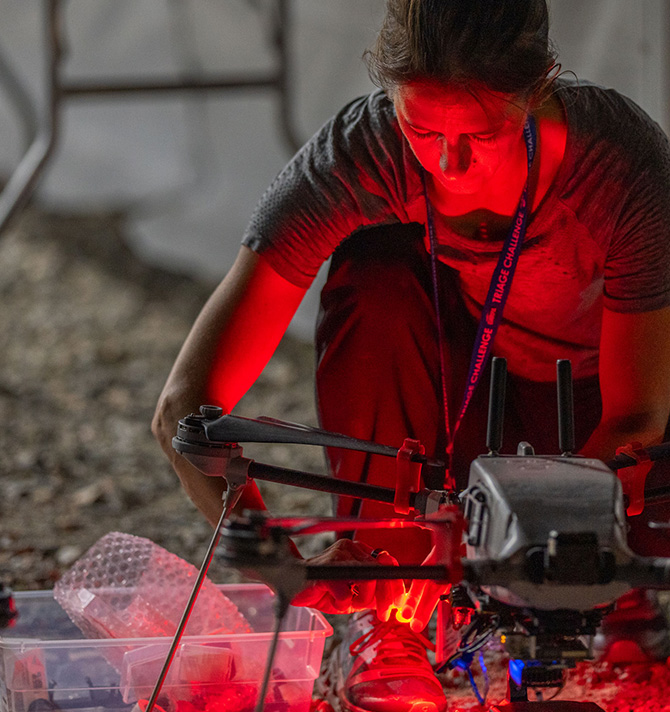
DARPA Triage ChallengeSource: DARPA | Paul Flacks

Triage

Transforming how medical responders triage in mass casualty incidents. | Learn more
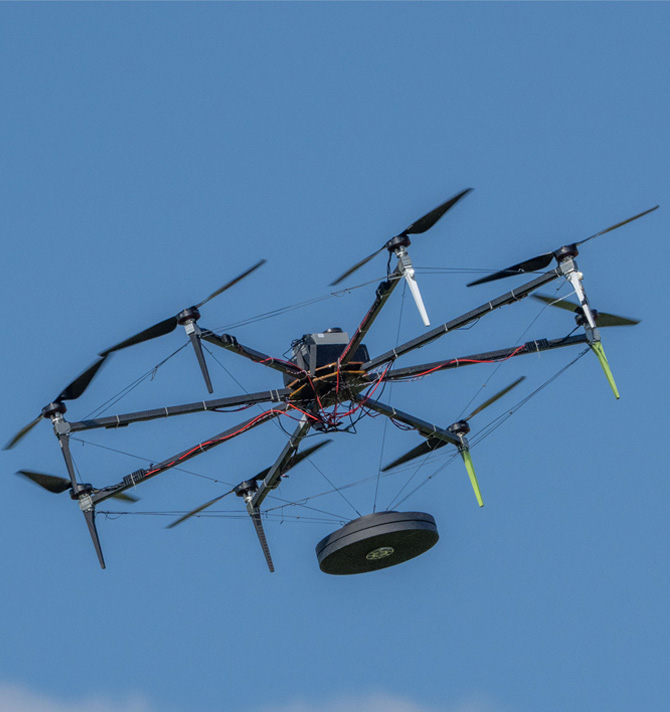
DARPA Triage ChallengeSource: DARPA | Paul Flacks

Lift

Seeking novel drone designs that can carry payloads more than four times their weight. | Learn more


Completed Challenges

  • Subterranean Challenge
    SubT explored new approaches to rapidly map, navigate, search, and exploit complex underground environments such as human-made tunnel systems, urban underground, and natural cave networks. The main scoring objective to search for, detect, and provide spatially referenced locations of artifacts placed in the environment. The challenge was completed in 2021. | Learn about augmenting underground operations
     
  • Robotics Challenge
    DRC promoted innovation in human-supervised robotic technology for disaster-response operations. The challenge developed human-supervised ground robots capable of executing complex tasks in dangerous, degraded, human-engineered environments. The challenge was completed in 2015. | Learn about the art of supervised autonomy


Competitions


Surgical

This competition seeks to accelerate the development of autonomous robotic systems for trauma surgery. The goal is to assist human surgeons, creating a force multiplier that provides "infinite" surgical capacity on demand.

Learn about Surgical collaboration


Sprints


D2 Sprint

Currently, 75% of pre-hospital combat casualty care is unrecorded.

To address this critical shortfall, DARPA has launched the Documentation and Decision Support (D2) Sprint, which will tasks teams to create AI tools capable of automatically assessing casualties, recommending treatments, guiding care, and seamlessly documenting the process.

Learn about documenting medical treatment

Completed Sprints

  • Bio-attribution Challenge
    This virtual competition called on innovators to develop a new generation of tools capable of analyzing petabyte-scale datasets in near real-time, far exceeding the capacity of current systems. The challenge was completed in 2026. | Find a "needle in a haystack"
  • CIDAR
    In the Computational Imaging Detection and Ranging Challenge, teams exploring the potential of computational imaging, machine learning, and artificial intelligence tools and techniques. The challenge was completed in 2026. | Learn about machine learning
     
  • AI for Critical Mineral Assessment Competition
    DARPA partnered with the United States Geological Survey (USGS) to explore the potential for machine learning (ML) and artificial intelligence (AI) tools and techniques to accelerate critical mineral assessments by automating key steps in the process. The challenge was completed in 2022. | See what we learned 


Contact