Three Years, Three Events
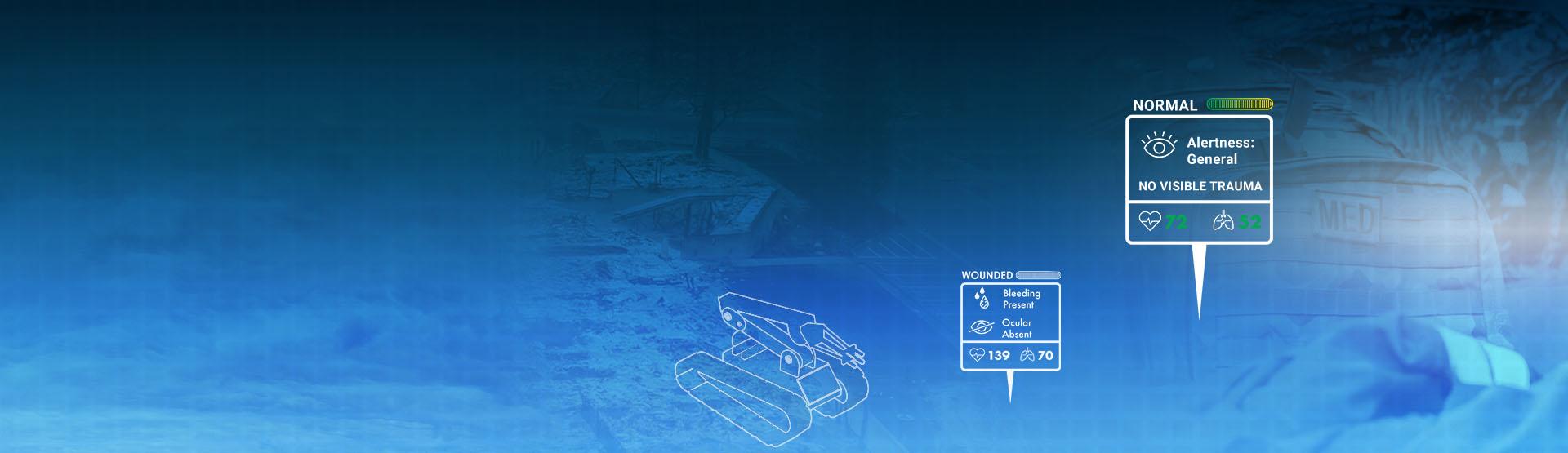
The DARPA Triage Challenge is a three-year effort that began in 2022, with separate events for teams in three categories: Systems, Data, and Virtual.
Each event featured multiple competitions that focused on a specific application of advanced technology to improve medical triage. Competition scenarios increased in complexity each year.
Competition Objectives
- Systems – Detect and identify physiological signatures of injury derived from data captured by stand-off sensors onboard autonomous systems.
- Data – Using real-world datasets from trauma centers, predict the need for life-saving interventions.
- Virtual – Working within a simulated environment and patient avatars, use data from real-world trauma centers to evaluate casualties. (This competition concluded with Event 1.)
Teams must successfully find, locate, and assess injuries. | 2:25
The first challenge event, held in September 2024 at Guardian Centers in Perry, Georgia, tested new technologies for medical triage during mass-casualty incidents. Teams used stand-off sensors on UAVs and UGVs to autonomously locate and assess casualties under realistic field conditions.
The event featured three parallel competitions — Systems, Data, and Virtual. The Systems competition focused on autonomous casualty detection in physical courses. The Virtual and Data competitions centered on simulated scenarios and real trauma-center datasets, tasking teams with developing algorithms to predict life-saving interventions based on accuracy and speed.
Teams completed qualifications before each challenge event.
Key Lessons Emerged
- Frequent testing and error correction are essential for progress
- Clear scoring criteria help teams align their approaches with real-world needs
- Robust solutions must overcome hardware challenges like overheating and bandwidth limits
Teams pursued diverse strategies, from refining data pipelines to creating specialized analysis tools, yielding insights that will drive stronger, more adaptable triage technologies.
Systems
Only self-funded teams who score within the top five are eligible for prize money in the first two years. Final score is the average of the top two runs.
| Team | R1 | R2 | R3 | Score |
| DART | 79 | 61 | 106 | 92.5 |
| Coordinated Robotics* | 77 | 52 | 91 | 84.0 |
| RoboScout | 71 | 37 | 75 | 73.0 |
| Chiron | 71 | 53 | 28 | 62.0 |
| UAS-DTU* | 13 | 54 | 27 | 40.5 |
| Engineering Dynamics* | 0 | 62 | 0 | 31.0 |
| PRONTO | 0 | 56 | 0 | 30.5 |
| AIR TAGS | 29 | 0 | 0 | 14.5 |
| POINTER | 0 | 19 | 0 | 9.5 |
| RAPID | 0 | 0 | 18 | 9.0 |
| TTT | 0 | 0 | 0 | 0.0 |
*Self-funded team
Data
Scoring criteria: Accuracy of LSI prediction, including any LSI and more specific classifications, such as hemorrhage or airway interventions.
| Team | R1 | R2 | Score |
| Coordinated Robotics* | 434 | 191 | 625 |
| MSAI* | 364 | 191 | 555 |
| CAMA* | 368 | 164 | 532 |
| LENS | 129 | 181 | 310 |
| AI TEMPO | 91 | 177 | 268 |
| CRITIC | 21 | 168 | 189 |
| TrueFit.AI* | 37 | 142 | 179 |
| Robotika* | 27 | 116 | 143 |
| ALICE | 18 | 91 | 109 |
| AUSTERE | 49 | 12 | 61 |
| MGB-Harvard* | 13 | 31 | 44 |
| CNA* | 8 | 27 | 35 |
*Self-funded team
Virtual
| Team | R1 | R2 | R3 | R4 | R5 | R6 | Score |
| Coordinated Robotics | 374 | 359 | 377 | 370 | 363 | 372 | 369.167 |
| Robotika | 360 | 328 | 332 | 354 | 339 | 359 | 345.333 |
| Engineering Dynamics | 337 | 338 | 340 | 329 | 316 | 345 | 334.167 |
| Second Sight | 274 | 301 | 311 | 273 | 302 | 328 | 298.167 |
| Flying Fitches | 290 | 286 | 287 | 269 | 265 | 288 | 280.833 |
| UAS-DTU | 91 | 110 | 103 | 117 | 89 | 109 | 103.167 |
| TTT | 0 | 0 | 0 | 0 | 0 | 0 | 0.000 |
Prizes
| Systems* | Data* | Virtual* | |
| Grand | $120,000 | $120,000 | $120,000 |
| 1st | $60,000 | $60,000 | $60,000 |
| 2nd | $20,000 | $20,000 | $20,000 |
*All teams
In September 2025, the challenges deepened. Challenged teams operated in degraded and obstructed environments that more closely reflected real-world disaster and battlefield conditions, including smoke, low light, and physical obstructions.
Systems teams faced degraded sensing, dynamic obstacles, darkness, and rugged terrain in on-site courses, while Data teams deployed more complex, noisy datasets to pinpoint critical physiological signatures.
Systems
Coordinated Robotics
$300,000
UAS-DTU
$150,000
Prizes are available only to self-funded teams in year two.
| Team | C130 | Night | Score |
| DART* | 536 | 192 | 728 |
| RoboScout* | 383 | 247 | 630 |
| Coordinated Robotics | 267 | 279 | 546 |
| PRONTO* | 321 | 162 | 483 |
| UAS-DTU | 109 | 278 | 387 |
| Chiron* | 176 | 181 | 357 |
| AIR TAGS* | 33 | 110 | 143 |
| Robotika | 36 | 0 | 36 |
| TTT | 0 | 0 | 0 |
*DARPA-funded team
No other self-funded teams achieved the minimum benchmark.
Data
Coordinated Robotics
$300,000
Prizes are available only to self-funded teams in year two.
| Team | R1 | R2 | R3 | Score |
| MSAI* | 25.87 | 25.99 | 25.53 | 77.39 |
| Coordinated Robotics | 26.40 | 25.05 | 24.40 | 75.86 |
| AI-TEMPO* | 24.24 | 24.50 | 23.86 | 72.60 |
| CRITIC* | 22.56 | 21.39 | 22.26 | 66.22 |
| LENS* | 18.53 | 19.76 | 21.88 | 60.17 |
| AID3D | 16.67 | 16.67 | 16.67 | 50.00 |
| Deep Breathe | 16.67 | 16.67 | 16.67 | 50.00 |
| CAMA | 16.93 | 16.73 | 15.86 | 49.53 |
| AUSTERE | 9.45 | 15.17 | 9.59 | 34.21 |
*DARPA-funded team
Run (R): Calculated as the sum of Mean Squared Correct (𝑀𝑆𝐶𝑟) for each case.
R1: Expanded EHR
R2: Basic EHR
R3: Vitals only
EHR: Electronic Health Records
Score: Sum of three runs.
*DARPA-funded team
No other self-funded teams achieved the minimum benchmark.
Prizes
| Systems* | Data* | |
| Grand | $300,000 | $300,000 |
| 1st | $150,000 | $150,000 |
| 2nd | $50,000 | $50,000 |
*Self-funded only
Event 3
The Challenge culminates with Event 3 – the Finals – in Disaster City, Texas (near College Station).
Awards Ceremony (invitation only)
Nov. 13 at 2 p.m. ET
Livestreamed from College Station, Texas
Timeline
Data and systems teams compete in separate finals events in 2026.
| Date | |
| Data competition | Oct. 10 |
| Systems competition | Nov. 5-13 |
| Awards ceremony | Nov. 13 |
| “ |
In a mass casualty event, every minute makes a difference — but today’s triage methods are time consuming and fragile. – Col. Jeremy C. Pamplin M.D., U.S. Army (Ret.), program manager, DARPA Triage Challenge
|
Voices from DARPA
Revolutionizing triage (DARPA Triage Challenge) | Ep 81