Testing Algorithms and Systems in Realistic Scenarios
Winners
Congratulations to the winners of the DARPA Triage Challenge.
These teams' innovative technologies will save lives on and off the battlefield.
Systems
Data
Autonomous platforms: Most lives saved on human-machine teaming lane
Technical capabilities: Overall performance on component testing gates
Prediction of life-saving interventions and resource allocation: Overall performance on first look, continuous triage and resource allocation
*Self-funded
Most Complex Environments Yet
Building on Events 1 and 2, the DARPA Triage Challenge Finals will take place in Disaster City, Texas – a purpose-built testbed near College Station designed to be realistic, rigorous, and outcome-focused.
Teams will have to operate in challenging conditions, including darkness, smoke, fire, varied terrain, buildings, and rubble.
Scenarios will emphasize human-machine teaming, lives saved, and standardized medic performance.
Systems
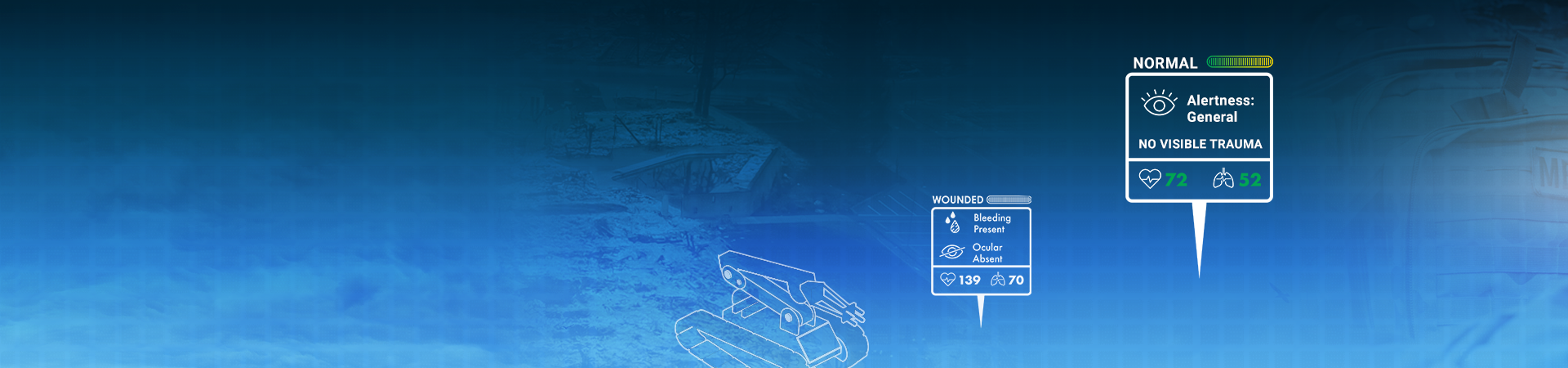
Autonomous or partially autonomous uncrewed aerial vehicles (UAVs) and uncrewed ground vehicles (UGVs) must accurately locate casualties, identify life-threatening injuries, conduct trauma assessments, capture vital signs from a standoff distance and share information with human medic teams. | Systems competition finals
Data
Using limited clinical data, algorithms must not only identify injuries but also predict any life-saving procedures that a casualty will need hours later. | Data competition finals
How Teams Win
Teams earn points for passing specific “gates,” such as finding a casualty and making a diagnosis. Scores reflect the speed and accuracy of results, with bonus points awarded for reporting casualties within the “golden window,” the period after injury when medical treatment is most likely to prevent death.
Teams must successfully find, locate, and assess injuries. | 2:25
Watch the awards ceremony recap.
Follow the finals
The Systems competition was in Disaster City in College Station, Texas.
Road to the Finals
Launched in 2022, the DARPA Triage Challenge featured separate competitions across three 12-month phases and three categories: Systems, Data, and Virtual. Before each competition, teams attended workshops to test their systems and algorithms.
Challenge Events 1 and 2 focused on specific aspects of using advanced technology to improve medical triage, from real-world robotic assessment to predicting a virtual patient's needs using limited clinical data.
Uncrewed ground vehicle assesses injuries of simulated casualty, night course, DARPA Triage Challenge Workshop 2.
Source: DARPA | Paul Flacks