The Need and Opportunity
Medical countermeasures against biological threats to warfighters have been a DARPA theme in recent years. One research trajectory centers on the challenge of producing millions of doses of vaccine using novel plantbased methods. But for any candidate vaccine or medical agent — let alone ones made in new ways — to enter clinical trials, there must be preclinical evidence of its safety in people.
Biomedical researchers most often turn to animal testing for this evidence, but these often fail to predict either safety or efficacy of the candidate drug in people. With an eye on improving and speeding up the preclinical phase of drug and countermeasures development to better accommodate the quick timescales at which new threats can emerge, DARPA launched the Microphysiological Systems (MPS) program in 2012.
The evaluation of potential medical countermeasures to new biological threats is particularly challenging using current methods because traditional testing consumes more time than might be available to effectively respond in a national emergency and it is often both impractical and unethical to evaluate countermeasures using human clinical trials. This is where the in vitro technology envisioned in the MPS program comes in.
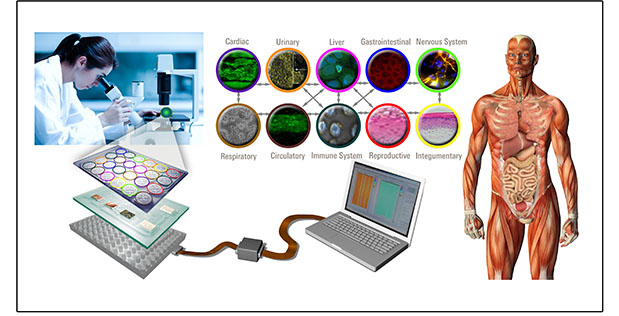
Within five years of the program’s inception, DARPA and the research performers it contracted to achieve the program’s goals delivered an in vitro platform to rapidly assess efficacy, toxicity, and pharmacokinetics (how a drug changes and behaves inside the body) of medical countermeasures in a way that is relevant to human health. The reconfigurable MPS platform uses a system of engineered human tissues that are interconnected with each other using microfluidic technology to recapitulate human physiology.
MPS performer teams demonstrated in Phase I of the program that the engineered tissues can function together to accurately reproduce both the human physiological systems they are intended to mimic and the biological crosstalk that occurs among the systems’ components.
Solution
At its start, DARPA’s managers of the MPS program set out to build on the limited fundamental research in organ-on-chip technology with the goal of developing these platforms not only for medical countermeasure applications but also for far wider use in the research and regulatory communities.
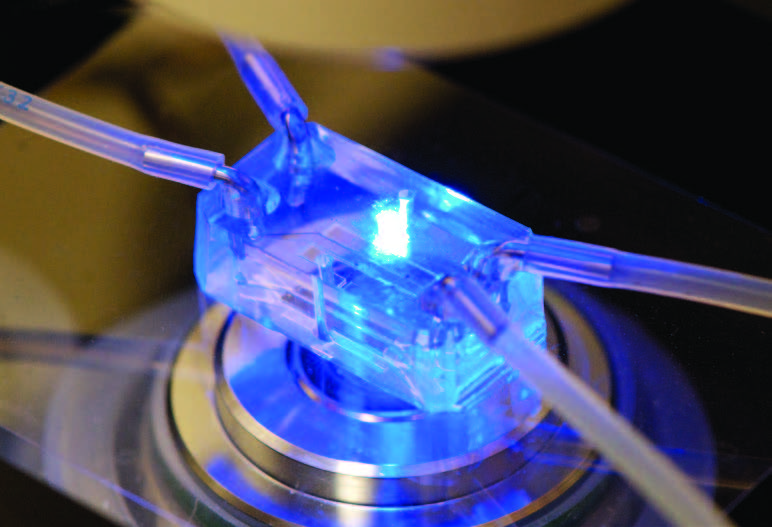
To accomplish this, DARPA partnered with NIH’s National Center for Advancing Translational Sciences (NCATS), which launched its own MPS-like program — the Tissue Chip for Drug Screening program — shortly after DARPA initiated the MPS program. The two agencies frequently held joint program meetings to promote and coordinate the fundamental research required to advance organ-on-chip technologies.
DARPA made significant investments to advance the in vitro biomedical testing concept and its related platform engineering by funding multidisciplinary teams from MIT and the Wyss Institute. These teams worked together to develop two unique platforms, each demonstrating a diversity of interconnected human tissue systems.
The base organ-on-chip module is composed of a clear flexible polymer — about the size of a computer memory stick — that contains hollow microfluidic channels lined with living human cells. Because the microdevices are translucent, they provide windows into the inner-workings of human organs without having to invade a living body.
The portfolio of individual microphysiological systems developed by the Wyss Institute include:
- Lung alveolus
- Lung airway
- Gut
- Heart
- Liver
- Kidney (proximal tubule)
- Airway smooth muscle
- Blood brain barrier
- Brain (neuronal networks)
- Skeletal muscle
- Skin
- Bone marrow
- Kidney (glomerulus)
- Placenta
For its part, the MIT team developed these modules:
- Liver-immune
- Lung
- Gut
- Endometrium
- Pancreas
- Brain
- Cardiac
- Skeletal muscle
- Skin
- Kidney
All of these individual organ-on-chip systems were built to be plugged and played (either alone or in combination with others to allow interaction) within the overall MPS framework for up to four weeks in order to test the safety and efficacy of agents intended as medical countermeasures. To validate the platform’s predictive ability, MPS performers tested compounds with known effects in humans.
The researchers observed appropriate responses to drugs (e.g., diclofenac, cisplatin, nicotine, etc.), which indicated the technology could be used reliably to investigate the impact of drugs and countermeasure on human systems. Additionally, to more fully address DARPA’s vision, the Wyss and MIT research teams, even at the start of their involvement, established commercialization plans.
MIT’s subcontractor, CN Bio Innovations, commercialized the MIT-invented organ-on-chip technologies and a multi-organ system. Wyss Institute spun out a startup company, Emulate Inc. The young firm raised over $93M in venture capital and currently is commercializing components of the Wyss-invented MPS platform while also offering services for industry, universities, and clinical partners.
Impact
The MPS program, which ended in 2019, exceeded expectations. In addition to the portfolio of organ-on-chip technologies now in hand, the original and now realized challenge to develop new preclinical predictive tools for drug development has led to consequential explorations into the efficacy and mechanisms of action of drug candidates.
Research in this arena is yielding insights into normal and abnormal tissue and organ function and is becoming especially useful in revealing disease processes. Meanwhile, as a result of DARPA’s efforts to accelerate the adoption of organ-on-chip platforms, other federal organizations have embraced the MPS approach to address their own mission. For example, the Environmental Protection Agency’s Science to Achieve Results (STAR) program is developing organ-specific culture models for predictive toxicology.
The U.S. Army Combat Capabilities Development Command’s Chemical Biological Center is turning to Emulate’s chips to support chemical and biological defense analysis and has made these valuable transition activities possible. The Food and Drug Administration’s Center for Drug Evaluation and its Center for Food Safety and Applied Nutrition are also using MPS platforms to assess drugs and other critical agents and compounds. So is the Defense Threat Reduction Agency’s X vivo Capability for Evaluation and Licensure (X.C.E.L.) Program.
Looking Ahead
Even with all of this transition of MPS technology from development into multiple applications and adoptions, the MPS platform could be used yet more broadly to ensure that safe and effective therapeutics are identified sooner and that ineffective and potentially toxic candidate therapeutics are rejected early in the development process.
The best potential payoffs for the technology — including an increase in the quality and quantity of new drugs moving successfully through the pipeline and into the clinic, better informed regulatory decision-making processes, and improved patient outcomes — all appear within reach.
You might also like
A self-healing system
16 seconds. That’s all it took for SBIR, Cyber First Aid, to unhack a compromised medical device. | Learn more

Revolutionizing naval capability
The USX-1 Defiant is an unmanned surface vessel designed from the ground up to never accommodate a human aboard. | Learn more

ARPANET, the internet's genesis
Packet-switching networks enabled resilient, distributed information sharing that transformed worldwide digital connectivity. | Learn more
Quantum sensing and computing
Establishing defense capabilities through ultra-precise sensing and revolutionary computational breakthroughs. | Learn more