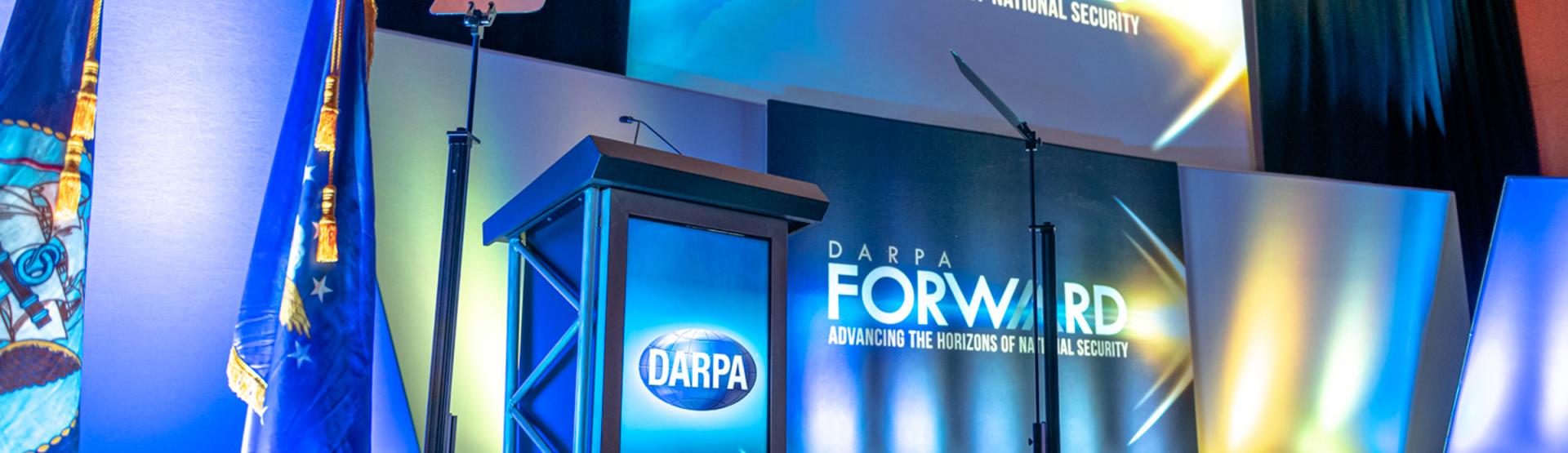
Pullman, Washington
Sept. 13-14, 2022
Keynotes
Chairman Adam Smith, House Armed Services Committee | 3:16
Adm. Samuel J. Paparo, Commander, US Pacific Fleet | 4:14
Vice Admiral Jon Hill, Director, Missile Defense Agency | 7:43
Winning at Cyber: Dr. John Launchbury, Chief Scientist, Galois & Founder and Chief Technical Officer, Tangram Flex describes how, through the use of mathematics-based development and assurance technologies, it is possible to create provably safe systems and effectively break this conflict spiral. | 7:18
Applying biologically sourced materials to build inorganic structures: Marrying MEMS to quantum sensing and computation will enable quantum computers to scale to heretofore unsolvable problems, while supporting new classes of highly miniature, low-cost sensors for military and everyday uses. Qubits are incredibly powerful, but their state information is fleeting. Dr. Amir Safavi-Naeini, Associate Professor of Applied Physics and a member of Ginzton Lab, Stanford University, discusses the implications | 6:13
Power everywhere: AI will enable a whole new class of autonomous capabilities and vehicles. However, there is a fundamental and practical problem that will hinder broader adoption: Power. TTO Program Manager Paul Calhoun explains. | 5:26
Enabling Next Generation Communications: Spectrum congestion increases relentlessly. Today, the RF electronics do not exist to support operation in this frequency band, due to both size and efficiency limitations. MTO Program Manager Thomas Kazior explains. | 6:14
U.S. Navy Unmanned Underwater Vehicles (UUVs) - Current and Future: A macro-level overview of current and planned U.S. Navy UUV programs. Capt. Jason Weed, Commodore, U.S. Navy, Unmanned Undersea Vehicles Squadron ONE (UUVRON-1). | 6:34
Semantic Forensics (SemaFor): This demonstration discusses the current state of the art in deepfakes and highlight a recent capability, developed under SemaFor, for authenticating videos that purport to be of a specific individual. I2O Deputy Director Matt Turek demonstrates. | 11:14 | Program: SemaFor
Domain-Specific System on Chip (DSSoC): IBM demonstrates their EPOCHS technology (developed under DARPA’s DSSoC program) to accelerate relevant applications that must execute simultaneously for connected autonomous vehicles (CAVs). MTO Program Manager Thomas Kazior demonstrates. | 11:40 | Program: DSSoC
Secure Handhelds on Assured Resilient Networks at the Tactical Edge (SHARE): Highlighting trusted group communication and resilient data sharing in the presence of disruption. STO Program Manager Mary Schurgot demonstrates. | 10:12 | Program: SHARE
Trustworthy AI for Adversarial Environments: DARPA's research in Trustworthy AI for Adversarial Environments is developing AI/ML technologies and systems that can be trusted to perform as expected despite the efforts of sophisticated adversaries. I2O Office Director Kathleen Fisher explains. | 44:59
Redefining Future Platforms: This presentation provides an overview of TTO's programs and potential opportunities for the future. TTO Office Director Michael Leahy explains. | 36:23
Understanding the Operational Environment: Highlights current challenge and opportunity spaces created from acquiring data collected across multiple domains and how that data can best be utilized to maintain vigilance. Moderator: BTO Deputy Director Kristen Jordan. Panel: Capt. Jason Weed, U.S. Navy, Commodore, Unmanned Undersea Vehicles Squadron ONE (UUVRON-1); Col. Trent Mills, U.S. Army, Special Assistant to the DARPA Director / U.S. Army Operational Liaison; Col. Ben Bishop, U.S. Air Force, Special Assistant to the DARPA Director; Col. Nathan Marvel, Commanding Officer, U.S. Marines, Marine Aircraft Group 39 | 45:24
Hardening Supply Networks for the Future: Discusses how new paradigms can play a role in ensuring resilient, trusted, and secure access to materials and products that are critical for DoD needs. Moderator: BTO Program Manager Linda Chrisey. Panel: Carl McCants, Special Assistant to the DARPA Director; Senthil Arul, Program Manager, DLA Research and Development; Wallace Patterson, Senior Program Manager, Air Force Research Laboratory’s Materials and Manufacturing Directorate (AFRL/RX). | 45:38
Will the Future of Computing be Digital?: Discusses the domain-specific performance measures that will define advanced computing in the future. Moderator: MTO Program Manager Bryan Jacobs. Panel: Brad Lackey, Senior Principal Researcher, Microsoft; Josh Fryman, Fellow, Intel Corporation; Jae-sun Seo, Associate Professor, Arizona State University School of Electrical, Computer and Energy Engineering. | 45:00
Systems of Autonomy: Describes the importance of autonomous systems to the DoD and examine the barriers, technical and otherwise, specific to the successful fielding operational use of autonomous systems and platforms. Moderator: STO Director Phil Root. Panel: Nic Radford, Founder, President and Chief Executive Officer, Nauticus Robotics; Timothy Chung, General Manager of Autonomy and Robotics, Microsoft; Matthew Johnson, Research Scientist, Institute for Human & Machine Cognition | 44:02
The Human Domain: Focuses on providing the context regarding the influence of emerging social, behavioral, and societal changes have on stability and security around the world. Moderator: David Danks, Professor of Data Science and Philosophy, University of California, San Diego. Panel: Sonja Schmer-Galunder, Principal Research Scientist, Smart Information Flow Technologies; James Evans, Professor, Knowledge Lab, University of Chicago Department of Sociology | 46:18