Explore by Tag
Explore by Tag
X
  • Access
  • Adaptability
  • Administration
  • Agency
  • AI
  • Air
  • Algorithms
  • Analytics
  • Automation
  • Autonomy
  • Bio-complexity
  • Bio-systems
  • BMC2
  • CBRN
  • Chemistry
  • Communications
  • Complexity
  • Contracts
  • Cost
  • Countermeasures
  • Cyber
  • Data
  • Decentralization
  • Disease
  • Electronics
  • Energy
  • Events
  • EW
  • Finance
  • Forecasting
  • Formal
  • Fundamentals
  • Games
  • Globalization
  • Ground
  • Health
  • History
  • Imagery
  • Injury
  • Integration
  • Interface
  • ISR
  • Language
  • Launch
  • Leadership
  • Logistics
  • Manufacturing
  • Maritime
  • Materials
  • Math
  • Med-Devices
  • Microchips
  • Microstructures
  • Microsystems
  • Mobile
  • Munitions
  • Networking
  • Neuroscience
  • Opportunities
  • Photonics
  • PNT
  • Policy
  • Privacy
  • Processing
  • Programming
  • Quantum
  • Resilience
  • Restoration
  • Robotics
  • Satellites
  • SBIR
  • Security
  • Sensors
  • Space
  • Spectroscopy
  • Spectrum
  • SWAP
  • Syn-Bio
  • Systems
  • Targeting
  • Tech-Foundations
  • Testimony
  • Therapy
  • Thermal
  • Training
  • Transition
  • Trust
  • Unmanned
  • Visualization
Defense Advanced
Research Projects Agency
Main Menu
X
  • About Us
    • About DARPA
    • People
    • Offices
    • Innovation Timeline
    • Testimony
    • Budget
    • Image Gallery
  • /
  • Our Research
  • /
  • News
  • /
  • Events
  • /
  • Work With Us
    • Opportunities
    • New Program Managers
    • Contract Management
    • For Industry
    • For Small Businesses
    • For Universities
    • For Government and Military
    • Employment at DARPA
    • Visitor Information
  • /
  • Search
Main Menu Explore by Tag
Defense Advanced Research Projects AgencyProgram Information

Explainable Artificial Intelligence (XAI)

Dr. Matt Turek

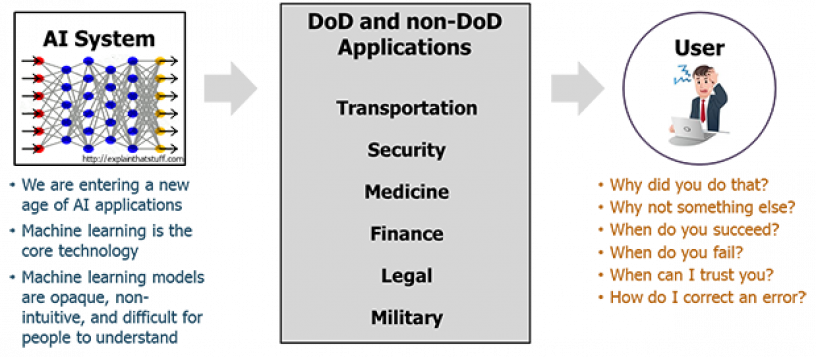
Figure 1. The Need for Explainable AI

Dramatic success in machine learning has led to a torrent of Artificial Intelligence (AI) applications. Continued advances promise to produce autonomous systems that will perceive, learn, decide, and act on their own. However, the effectiveness of these systems is limited by the machine’s current inability to explain their decisions and actions to human users (Figure 1). The Department of Defense (DoD) is facing challenges that demand more intelligent, autonomous, and symbiotic systems. Explainable AI—especially explainable machine learning—will be essential if future warfighters are to understand, appropriately trust, and effectively manage an emerging generation of artificially intelligent machine partners.

The Explainable AI (XAI) program aims to create a suite of machine learning techniques that:

  • Produce more explainable models, while maintaining a high level of learning performance (prediction accuracy); and
  • Enable human users to understand, appropriately trust, and effectively manage the emerging generation of artificially intelligent partners.

New machine-learning systems will have the ability to explain their rationale, characterize their strengths and weaknesses, and convey an understanding of how they will behave in the future. The strategy for achieving that goal is to develop new or modified machine-learning techniques that will produce more explainable models. These models will be combined with state-of-the-art human-computer interface techniques capable of translating models into understandable and useful explanation dialogues for the end user (Figure 2). Our strategy is to pursue a variety of techniques in order to generate a portfolio of methods that will provide future developers with a range of design options covering the performance-versus-explainability trade space.

Figure 2. XAI Concept

XAI is one of a handful of current DARPA programs expected to enable “third-wave AI systems”, where machines understand the context and environment in which they operate, and over time build underlying explanatory models that allow them to characterize real world phenomena.

The XAI program is focused on the development of multiple systems by addressing challenge problems in two areas: (1) machine learning problems to classify events of interest in heterogeneous, multimedia data; and (2) machine learning problems to construct decision policies for an autonomous system to perform a variety of simulated missions. These two challenge problem areas were chosen to represent the intersection of two important machine learning approaches (classification and reinforcement learning) and two important operational problem areas for the DoD (intelligence analysis and autonomous systems).

In addition, researchers are examining the psychology of explanation.

XAI research prototypes are tested and continually evaluated throughout the course of the program. In May 2018, XAI researchers demonstrated initial implementations of their explainable learning systems and presented results of initial pilot studies of their Phase 1 evaluations. Full Phase 1 system evaluations are expected in November 2018.

At the end of the program, the final delivery will be a toolkit library consisting of machine learning and human-computer interface software modules that could be used to develop future explainable AI systems. After the program is complete, these toolkits would be available for further refinement and transition into defense or commercial applications.


Tags

| AI | Analytics | Autonomy | Data | Interface | Programming | Trust |


Similarly    Tagged    Content

Habitus
Dr. Bartlett Russell
Accelerated Molecular Discovery
SAIL-ON Proposers Day
Systematizing Confidence in Open Research and Evidence (SCORE) Proposers Day

Images

  • Explainable Artificial Intelligence - Figure 1
    Explainable Artificial Intelligence - Figure 1
  • Explainable Artificial Intelligence - Figure 2
    Explainable Artificial Intelligence - Figure 2

Resources

DARPA-BAA-16-53
DARPA-BAA-16-53: Proposers Day Slides
XAI Program Portfolio
Back To Top

  • Print


Selected DARPA Achievements

DARPA collaborated with industry on stealth technology.
DARPA’s Stealth Revolution
In the early days of DARPA’s work on stealth technology, Have Blue, a prototype of what would become the F-117A, first flew successfully in 1977. The success of the F-117A program marked the beginning of the stealth revolution, which has had enormous benefits for national security.
DARPA microelectronics gave rise to today's GPS devices.
Navigation in the Palm of Your Hand
Early GPS receivers were bulky, heavy devices. In 1983, DARPA set out to miniaturize them, leading to a much broader adoption of GPS capability.
First rough conceptual design of the ARPANET.
Paving the Way to the Modern Internet
ARPA research played a central role in launching the Information Revolution. The agency developed and furthered much of the conceptual basis for the ARPANET—prototypical communications network launched nearly half a century ago—and invented the digital protocols that gave birth to the Internet.
  • About Us
  • About DARPA
  • People
  • Offices
  • Innovation Timeline
  • Testimony
  • Budget
  • History list page
  • Image Gallery
  • Our Research
  • Open Catalog
  • News
  • Events
  • Work With Us
  • Opportunities
  • New Program Managers
  • Contract Management
  • For Industry
  • For Small Businesses
  • For Universities
  • For Government and Military
  • Employment at DARPA
  • Site Info
  • Sitemap
  • Cookie Disclaimer
  • Web Policy
  • Privacy Policy
  • Accessibility/Section 508
  • No Fear Act
  • Whistleblower Protection Act
  • Usage Policy
  • DoD Hotline
  • USA.gov
  • /
  • Freedom of Information Act
  • /
  • Privacy and Civil Liberties
  • /
  • Visitor Information
  • /
  • Contact Us
  • Twitter
  • Facebook
  • YouTube
  • Instagram
  • Linked In
  • RSS
Defense Advanced Research Projects Agency 675 North Randolph Street
Arlington, VA 22203-2114
703.526.6630

This is an official U.S. Department of Defense website sponsored by the Defense Advanced Research Projects Agency.

You are now leaving the DARPA.mil website that is under the control and management of DARPA. The appearance of hyperlinks does not constitute endorsement by DARPA of non-U.S. Government sites or the information, products, or services contained therein. Although DARPA may or may not use these sites as additional distribution channels for Department of Defense information, it does not exercise editorial control over all of the information that you may find at these locations. Such links are provided consistent with the stated purpose of this website.


After reading this message, click  to continue immediately.

Go Back