


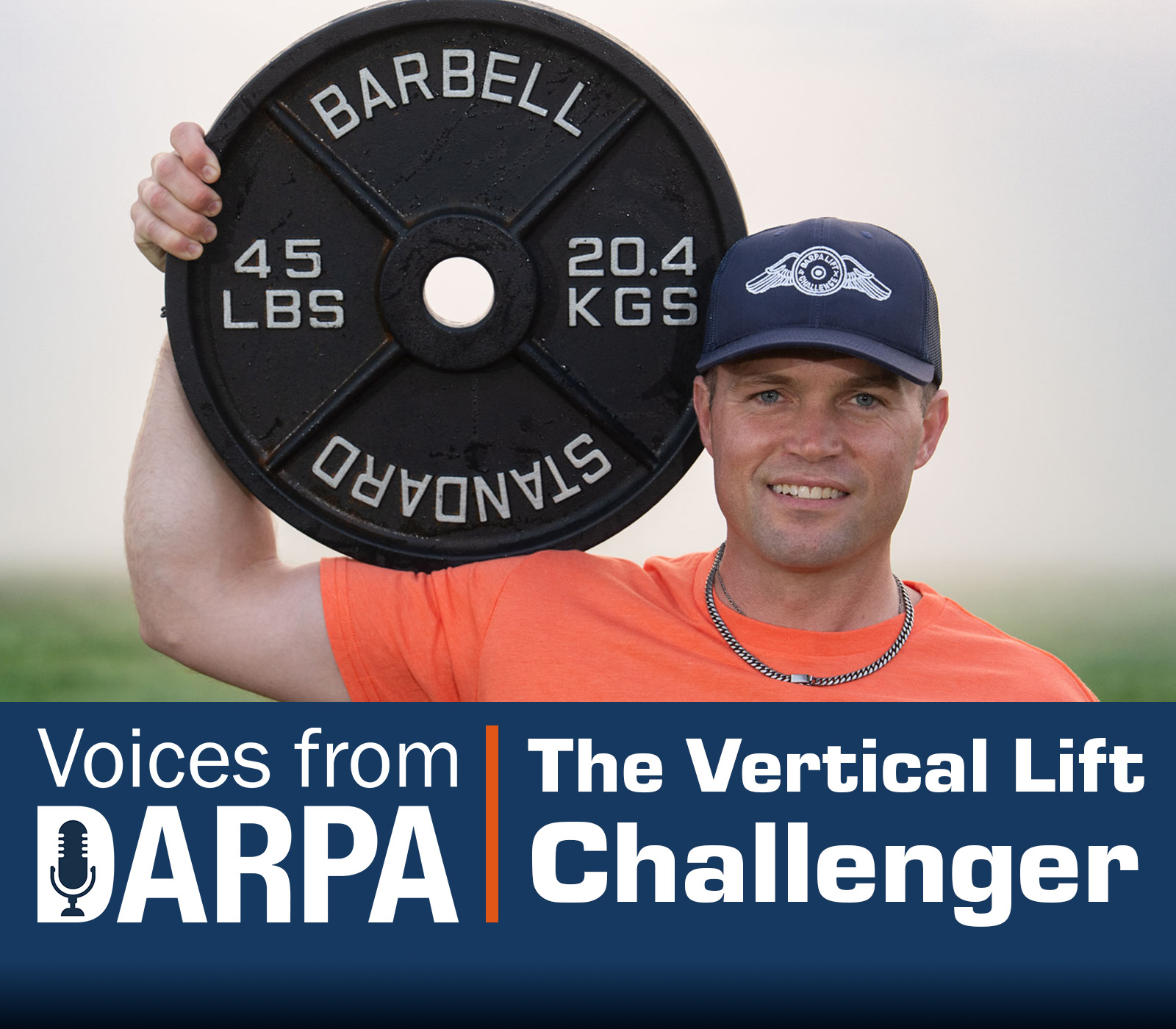
Voices from DARPA
The Vertical Lift Challenger | Ep 97
Oct. 1, 2026
Voices
- Phillip "Donna" Smith, program manager, Tactical Technology Office
- Host: Tom Shortridge, Public Affairs
How can vertical lift move more with less?
In this episode of Voices from DARPA, we discuss how a logistics challenge sparked a movement to break a nearly century-old barrier holding back heavy vertical-lift aircraft.
Phillip “Donna” Smith is a program manager in DARPA’s Tactical Technology Office. He oversees several of the agency’s aerial drone programs, including the Lift Challenge, a national public competition that began with one simple metric: improve payload-to-weight ratio in vertical aircraft, which currently lift only as much as they weigh.
What began as a hypothesis that these aircraft could lift four times their current weight using more aerodynamic designs, new materials, and better flight controls rapidly became a path to even higher payload efficiency.
Smith shares insights from the 2026 competition and what led to the decision to go for even bigger goals in 2028.
Additional Lift Challenge information, competition recaps, and upcoming milestones are available at www.darpa.mil/lift.
###
Media with inquiries should contact DARPA Public Affairs at outreach@darpa.mil
Intro Voices
Coming to DARPA is like grabbing the nose cone of a rocket and holding on for dear life.
DARPA is a place where if you don't invent the internet, you only get a B.
A DARPA program manager quite literally invents tomorrow.
Coming to work every day and being humbled by that.
DARPA is not one person or one place. It's a collection of people that are excited about moving technology forward.
Tom Shortridge
Hello and welcome to Voices from DARPA. I'm your host, Tom Shortridge.
We rarely notice logistics unless they fail. From the package delivered to your doorstep to supplies reaching the most austere environments on earth, the hard part isn't moving tons of cargo across oceans. It's that final, messy, unpaved mile. Philip Smith, call sign Donna, program manager in DARPA's Tactical Technology Office, learned that lesson early in his military career.
Philip “Donna” Smith
I think it comes back to my time in the Marine Corps, going through a number of war games and scenarios, my deployment time and seeing how much depends on logistics. One of our former commandants of the Marine Corps, Commandant Berger, described logistics as the pacing capability that we need to invest in and that we need to construct our force around. And there's old sayings, you know, amateurs talk tactics and professionals talk logistics. So the more and more I got into studying and analyzing both past and potential future conflicts, it really came down to logistics as the key function.
Tom Shortridge
Getting gear across an ocean to a paved runway is a solved problem. The real friction happens when things are a little less pedestrian. And that headache isn't confined to the military.
Philip “Donna” Smith
We've had fixed-wing aviation, we've had fixed-wing logistics for decades, right? 100 years. And it still has not given us the level of logistics, especially on the micro-distribution level that we need in order to be able to close those gaps in our capabilities. And then the same thing on the civilian side, I saw sci-fi has been talking about us flying around forever, and it's funny because it's like, you know, a book written in the 50s says by 1990 we'll be flying to work and everything. And here we are past the 1990s and we're still not there. I saw this as a really good dual-use case, which led us to the challenge format, but also something that I believed was, you know, feasible, right? That was physically possible. A lot of people have really great ideas about the future, but no path towards it. And so the DARPA system, if you will, the DARPA way with the high-mar questions and everything, really forces you to to nail down, right? And not just throw spaghetti at the wall and see what sticks. It's like, no, no, no, you need to actually have a technical basis and foundation to be able to make those types of changes, right?
Tom Shortridge
Look at modern battlefields. Small, uncrewed aircraft are everywhere. Yet anyone trying to move actual cargo with them runs headfirst into a harsh mathematical ceiling.
Philip “Donna” Smith
The problem is that they're very inefficient, the drones that they're using. They can only carry small payloads. If you want to go up to larger payloads, you need significantly larger aircraft, which is costly, easier to shoot down. There's a number of problems with those, right? So the vision on the battlefield or on the military side is that we have drones flying all around with heavier payloads, whether that's munitions or or basic logistics or even sensors, power capabilities to be able to to host those and power those sensors. And then on the civilian side, we have the same thing. We've had test markets now for grocery delivery. There's a couple of them across the United States. And they've really, I believe, they have failed because of the consumer draw. And when you think about it, right now, those test markets are only delivering 5-pound, 10-pound deliveries. And that's because they have an upper limit of the 55 pounds with a part 107.
Tom Shortridge
Part 107 is the Federal Aviation Administration's regulation for operating small drones, no matter where or who you are in America. It allows you to transport property for compensation or hire as long as the drone and everything it carries weighs less than 55 pounds total. The challenge is, existing commercial drones can only carry about a quarter of their own weight. So a 10-pound payload requires a 40-pound drone. That leaves you with a payload-to-weight ratio of roughly 1 to 4.
Philip “Donna” Smith
So if we were to flip that and you were to say, hey, we have a 4-to-1 ratio, that means now you can have a 10-pound aircraft lifting 40-ish pounds of groceries, and that now becomes valuable to the customer. The hypothesis is if we can make such a dramatic increase in efficiency of vertical lift through this payload-to-weight ratio, then we can reduce the cost per pound per mile. And now we can democratize the use of vertical lift aviation. Small businesses, medium-sized businesses, or the everyday human can start gaining and reaping the benefits of vertical lift aviation like we've have wanted for decades.
Tom Shortridge
That was the aim of the 2026 DARPA Lift Challenge, incentivizing competitors to create vertical lift aircraft weighing less than 55 pounds that could carry at least 110 pounds. But not just get it up into the air, they then had to carry that payload for four miles, drop it off and complete an additional mile unloaded inside a time limit of 30 minutes. All with the goal of achieving a 4-to-1 payload-to-weight ratio. Now, don't try this at home. Remember that part 107 55-pound rule. DARPA got an exemption from the FAA so that competitors could test their drones with the higher payloads.
Compressing that kind of ambitious goal into a nine-month sprint called for casting the widest possible net. DARPA wanted to see what would happen if you opened the aperture to builders of all kinds, bringing fresh ideas and unconventional perspectives into the arena.
Philip “Donna” Smith
The barriers to entry for teams is something that we looked into very, very hard when we were constructing the basic elements of the challenge. And we really looked at each one of the different types of teams that we wanted to join, whether that was academic, private, garage innovators, small businesses. And we said what would allow them to join. So I think that had a lot of payoffs because of the interest. And then this was a very short challenge or program for DARPA. It was 11 months from approval to actual execution and about nine months for the teams to be able to build design. A little bit of a surprise was the number of people that we got was really encouraging. There is a community out there that is, you know, really willing and able to take on the next challenge. And then the the dedication, I guess, too, of of these people, of seeing these innovators from everywhere from like a guy in a cornfield starting something new and that is exactly why we do challenges, right? Because sometimes in a academic institution or a scientific institution, you get inside of your own box and you don't try new things. You don't say, okay, let's open it up. Let's see what is out there, right? I think that is something that we need to be able to do is constantly break out of our comfort zones, break out of our preconceived notions of what we think the answer is. Let's give it a fair shot and go and try it.
Tom Shortridge
When an idea is truly radical, nine months is barely enough time to keep the parts from shaking loose in mid-air. That created a conundrum for the judges.
Philip “Donna” Smith
The prizes and grading metrics, we had objective and subjective. Part of that was because, you know, the objective is normal. This is a challenge, your first, second, third place, that's what you do, right? The person who comes out and performs the best. What we knew with such a short program is that there was a possibility that the truly revolutionary technologies that would take us into the future were not ready yet and would not make it onto the leaderboard. And so we wanted to recognize those. So the subjective categories were really to look at those people who were going out and trying something new, fully realizing that they may not even come close to the 4-to-1 ratio because it was so nascent, right? It was so new and they hadn't worked out the kinks. So the subjective categories to me as a technologist and as a person looking towards what's next in the future was more important and it was actually more exciting to see those. And what it also allowed is innovators to know that they could think outside of the box and try something new and still be rewarded for that effort, for that innovation, rather than only having the objective and being limited to those kind of capabilities. So it really, it had an amazing effect on the community and on the innovation that we saw by just saying there are other ways to be rewarded for your efforts other than just making it on the leaderboard.
Tom Shortridge
When competition week arrived, there was no quiet proving ground to work on bugs in secret. Every run happened in plain sight on an open airfield. And on YouTube, we'll have a link to the playlist in the show notes.
You know, development is risk-taking. And so to see people go up there and risk something that they had just spent nine months building to go out there and be like, for the spirit of aviation, for the spirit of innovation, for pushing the boundaries, we're going to put all that on the line and go out there. And oh, by the way, we had cameras on them, right? So there was the future of their company that they had to think of to go out there and and say, yeah, I'm going to crash this thing, risk the money, the time, the effort, and also possibly my reputation, all for the sake of trying to break a boundary. It was pretty amazing to watch.
By pairing an aggressive target with an open competition, DARPA engineered a shift in flight test culture, verifying clean sheet designs in an operational setting in real time. It drew out an extraordinary range of thinking, both in submitted designs and on the flight line.
Philip “Donna” Smith
We saw a number of new engine designs, and some of them are old engine designs that have just been like, hey, this is we finally solved the problem in that design. Some of them were in combinations of fuel and generators. So that's been an Achilles heel of hybrid aircraft. Now, we have it on cars and ships, but cars and ships don't have the weight problem like we do in aviation. So making those hybrid generator systems light enough and also efficient enough to be able to be in an aircraft has been a problem.
So we saw not only the the gas engines or or fuel-based engine, and some of those just didn't make it in time. There it takes a lot of work to be able to make some of these engines. And we saw the generators, so the hybrid generators, and then also we saw some revolutionary stuff on the electric motor side as well. And a lot of these are in research papers or in, you know, you can kind of see some YouTube videos about people tooling around with them or tinkering. And we think a lot of those are just on the cusp of being used. And we would love to see some of that, right? Some breakthroughs in those basics.
On the structures, we actually didn't see a lot of novel structures. So we, most people were out there just using carbon fiber. It was cheap, it was available, they didn't have to custom make it. Now, a caveat to that is some people had those custom-made parts but crashed prior to the competition. And that either caused them to drop out or they had to just pull an off-the-shelf carbon fiber tube or something else, right, to be able to fix it and get to the competition.
But there's some novel materials that we've seen, some 3D print filaments that are lighter than aluminum, stronger than steel, things like that. There's some architectures, bio-inspired architectures where you can create a lattice with 3D printing that makes a structure, you know, X amount stronger and lighter than its steel or even carbon fiber components.
So and then aerodynamics, we saw a number of the prop-driven rotors out there. Almost all of them had control problems, which if you look back in the history of aviation, that is the first step that happens, right? You build something that can fly and then you're like, oh man, how do I control this thing, right? So a number of teams just needed a couple more months and the authority, the policy that allowed them to continue to test.
Tom Shortridge
Though no team completed a full run at the goal 4-to-1 payload-to-weight ratio, several came tantalizingly close, resetting what conventional wisdom thought was possible.
Philip “Donna” Smith
Super excited about DLC and what happened, but we're also excited about the future of what is possible with a combination of these different types of technologies. So we ended up seeing a lot of the same designs, just improvements on those designs. You know, the helicopter was first and third place and also fourth place, a standard helicopter. And so what all the PhDs in vertical lift and everything said, you know, all these people said it's impossible. It was actually possible with the same technology that we have, just modernized and efficientized, which is actually a totally different outcome than we thought would happen with this challenge. I think for the community in general, the biggest surprise was that batteries was first and second. Now, that's bound in the parameters of nine months and all the billions of dollars that have been put into batteries and technology, but that was technically that was a big surprise. Fundamentally on where the science is, that was a big surprise. So look at all those bubbling up, right? So the ones we had at the challenge and actually the better part for us here is all the ones that applied and seeing all of those technologies and saying, actually, the stuff that didn't make it to DLC is the breakthrough. And that is very interesting to see. We did this 4-to-1 and people said, that's impossible, don't do it. Now we're like, wait, if 4-to-1 is possible with our kind of better current technology and we see the groundswell of new innovation, and that's across engines or motors, you know, electric or gas, batteries and other fuels, structures, and aerodynamics. If we actually add those, what is the new limit? We don't even know.
Tom Shortridge
With margin left in the envelope, DARPA sees the momentum to keep development moving, starting with a small business innovation research topic, or SIBER.
Philip “Donna” Smith
We don't do things at DARPA just for, you know, a show or demonstration. We always do it for an end use and actually like moving into commercialization into productization of the thing that we're doing. And so a part of that is those SIBERs focused on that powertrain and the aerodynamic development. So that we're hoping will kickstart a lot of these non-traditional designs that we see promise in that either came to the competition or weren't able to because they failed in one way or another. That doesn't mean that their idea wasn't good, right? And that it doesn't need a little bit of a bump and a help to be able to get it to market. So really excited about that. And that ties into the community, the commercial strategies office coming in, bringing in investors. And then also a big part of the media campaign that we've done to get the word out to people, buyers, builders, developers, investors that, hey, this is real. These breakthroughs are real. It is not some hidden, you know, science project that can't be verified. It was live-streamed to the world on YouTube. So this is the future, right? This is the investment opportunity if you want to get in early and build out what people will be buying in 5 to 10 years. When you combine all of these nascent technologies together, is the sum greater than the parts, right? And people need time to be able to do that. They need credibility, notoriety, they need sponsorship. And so what we accomplished in DLC 1 is building that community, building the the fame, the notoriety, not because we want to be on on, you know, YouTube hits or whatever. It's because we want to get the investors aware. It's because we want to reach out and say, hey, are you've been working on an engine, new engine technology. Now you can pair that with an airframe designer, and your powers combined, right? You'll achieve something even better.
Tom Shortridge
The untapped potential surrounding the lift challenge led DARPA to build on its success with a second competition announced for summer 2028, where aircraft will continue to be 55 pounds or less. The minimum payload for prizes is doubled to 220 pounds, and a new course design that will double in length.
That untapped potential is not just of teams who competed at the first lift challenge, but those who submitted concepts that weren't able to be flight-ready in nine months, of university researchers and scientists whose theoretical papers can leap off the page and onto the flight line, of investors and industries whose eyes opened to possibility, and of a broader community of innovators now willing to break out of their comfort zones and rethink vertical lift entirely.
Philip “Donna” Smith
The reach that DLC 1 had might be the most powerful thing. And so now capitalizing on that reach and going farther in DLC 2, allowing two years now instead of the 9, 11 months, will allow people to actually join, form teams, find sponsorships, and develop those more like leading-edge technologies that can make even higher breakthroughs, right? And so that's what we're really excited about. That's what we're going to try and facilitate those teaming opportunities, the ability to, you know, say, hey, this research institution wrote a paper about something. Okay, now let's actually put it into practice.
Well, that takes money. Okay, well, here's some sponsorship that we found from, you know, corporate VCs, whatever it is, that allows you to be able to experiment with that technology. And then see what is the limit. That's pretty exciting.
Tom Shortridge
What started as a question over tactical supply lines and delivery limitations ended up shattering conventional wisdom, proving that vertical lift platforms can carry multiple times their own weight at useful payload sizes and setting the stage for a thriving ecosystem of aviation innovation.
As inventors, engineers, industry partners and others coalesce and prepare for the next round of competition, the dream of agile, accessible, heavy vertical lift is turning into operational reality.
To learn how to get involved, track upcoming milestones and follow the teams, head over to darpa.mil/lift. That's also where you'll find recaps and details on the 2026 competition. That's all for this episode of Voices from DARPA.
As always, thanks for listening.
| “ |
We don't do things at DARPA just for a show or demonstration. We always do it for an end use and actually like moving into commercialization, into productization of the thing that we're doing. – Phillip “Donna” Smith program manager, Tactical Technology Office |
Subscribe


