Explore by Tag
Explore by Tag
X
  • Access
  • Adaptability
  • Administration
  • Agency
  • AI
  • Air
  • Algorithms
  • Analytics
  • Automation
  • Autonomy
  • Bio-complexity
  • Bio-systems
  • BMC2
  • CBRN
  • Chemistry
  • Communications
  • Complexity
  • Contracts
  • Cost
  • Countermeasures
  • Cyber
  • Data
  • Decentralization
  • Disease
  • Electronics
  • Energy
  • Events
  • EW
  • Finance
  • Forecasting
  • Formal
  • Fundamentals
  • Games
  • Globalization
  • Ground
  • Health
  • History
  • Imagery
  • Injury
  • Integration
  • Interface
  • ISR
  • Language
  • Launch
  • Leadership
  • Logistics
  • Manufacturing
  • Maritime
  • Materials
  • Math
  • Med-Devices
  • Microchips
  • Microstructures
  • Microsystems
  • Mobile
  • Munitions
  • Networking
  • Neuroscience
  • Opportunities
  • Photonics
  • PNT
  • Policy
  • Privacy
  • Processing
  • Programming
  • Quantum
  • Resilience
  • Restoration
  • Robotics
  • Satellites
  • SBIR
  • Security
  • Sensors
  • Space
  • Spectroscopy
  • Spectrum
  • SWAP
  • Syn-Bio
  • Systems
  • Targeting
  • Tech-Foundations
  • Testimony
  • Therapy
  • Thermal
  • Training
  • Transition
  • Trust
  • Unmanned
  • Visualization
Defense Advanced
Research Projects Agency
Main Menu
X
  • About Us
    • About DARPA
    • People
    • Offices
    • Innovation Timeline
    • Testimony
    • Budget
    • Image Gallery
  • /
  • Our Research
  • /
  • News
  • /
  • Events
  • /
  • Work With Us
    • Opportunities
    • New Program Managers
    • Contract Management
    • For Industry
    • For Small Businesses
    • For Universities
    • For Government and Military
    • Employment at DARPA
    • Visitor Information
  • /
  • Search
Main Menu Explore by Tag
Defense Advanced Research Projects AgencyNews And Events

CODE Demonstrates Autonomy and Collaboration with Minimal Human Commands

Ground and flight tests highlight CODE-equipped UASs’ ability to collaboratively sense and adapt to locate and respond to unexpected threats and new targets

outreach@darpa.mil
11/19/2018
CODE

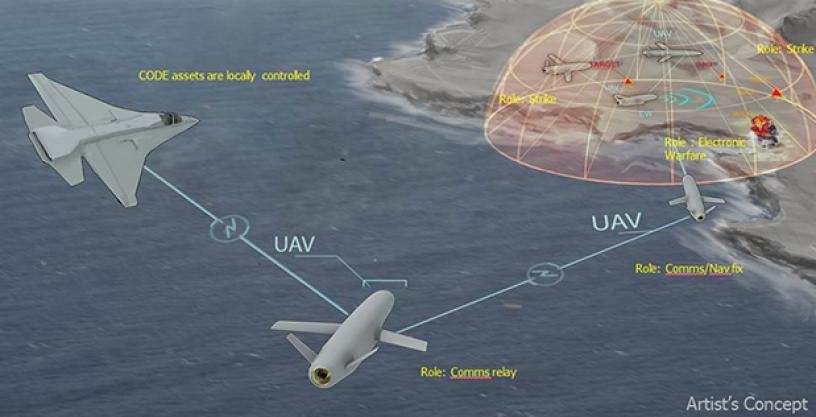
In a recent test series at Yuma Proving Ground in Arizona, DARPA’s Collaborative Operations in Denied Environment (CODE) program demonstrated the ability of CODE-equipped Unmanned Aerial Systems (UASs) to adapt and respond to unexpected threats in an anti-access area denial (A2AD) environment. The UASs efficiently shared information, cooperatively planned and allocated mission objectives, made coordinated tactical decisions, and collaboratively reacted to a dynamic, high-threat environment with minimal communication.

The air vehicles initially operated with supervisory mission commander interaction. When communications were degraded or denied, CODE vehicles retained mission plan intent to accomplish mission objectives without live human direction. The ability for CODE-enabled vehicles to interact when communications are degraded is an important step toward the program goal to conduct dynamic, long-distance engagements of highly mobile ground and maritime targets in contested or denied battlespace.

“The test series expanded on previously demonstrated approaches to low bandwidth collaborative sensing and on-board planning. It demonstrated the ability to operate in more challenging scenarios, where both communications and GPS navigation were denied for extended periods,” said Scott Wierzbanowski, DARPA program manager for CODE.

During the three-week ground and flight test series in a live/virtual/constructive (LVC) environment, up to six live and 24 virtual UASs served as surrogate strike assets, receiving mission objectives from a human mission commander. The systems then autonomously collaborated to navigate, search, localize, and engage both pre-planned and pop-up targets protected by a simulated Integrated Air Defense System (IADS) in communications- and GPS-denied scenarios.

“The demonstrated behaviors are the building blocks for an autonomous team that can collaborate and adjust to mission requirements and a changing environment,” said Wierzbanowski.

The DARPA team also has advanced the infrastructure necessary to support further development, integration, and testing of CODE as it transitions to future autonomous systems.

Achievements include incorporation of third-party autonomy algorithms into the current software build, the creation of a government repository and lab test environment for the CODE algorithms, and the successful demonstration of the Johns Hopkins University Applied Physics Laboratory White Force Network capability to provide constructive threats and effects in an LVC test environment.

CODE’s scalable capabilities could greatly enhance the survivability, flexibility, and effectiveness of existing air platforms, as well as reduce the development times and costs of future systems.

Further development of CODE and associated infrastructure will continue under DARPA until the conclusion of the program in spring 2019, followed by full transition of the CODE software repository to Naval Air Systems Command.

Image Caption: CODE artist’s concept


# # #


Media with inquiries should contact DARPA Public Affairs at outreach@darpa.mil


Associated images posted on www.darpa.mil and video posted at www.youtube.com/darpatv may be reused according to the terms of the DARPA User Agreement, available here: http://go.usa.gov/cuTXR.


Tweet @darpa


Tags

| Air | Autonomy | Unmanned |


Similarly    Tagged    Content

OFFSET Proposers Day
SubT Challenge Proposers Day
Subterranean Challenge Competitors Day
Subterranean Challenge Tunnel Circuit
Subterranean Challenge Identifies Urban Circuit Location, Updates Prize Amounts
Back To Top

  • Print


Selected DARPA Achievements

DARPA collaborated with industry on stealth technology.
DARPA’s Stealth Revolution
In the early days of DARPA’s work on stealth technology, Have Blue, a prototype of what would become the F-117A, first flew successfully in 1977. The success of the F-117A program marked the beginning of the stealth revolution, which has had enormous benefits for national security.
DARPA microelectronics gave rise to today's GPS devices.
Navigation in the Palm of Your Hand
Early GPS receivers were bulky, heavy devices. In 1983, DARPA set out to miniaturize them, leading to a much broader adoption of GPS capability.
First rough conceptual design of the ARPANET.
Paving the Way to the Modern Internet
ARPA research played a central role in launching the Information Revolution. The agency developed and furthered much of the conceptual basis for the ARPANET—prototypical communications network launched nearly half a century ago—and invented the digital protocols that gave birth to the Internet.
  • About Us
  • About DARPA
  • People
  • Offices
  • Innovation Timeline
  • Testimony
  • Budget
  • History list page
  • Image Gallery
  • Our Research
  • Open Catalog
  • News
  • Events
  • Work With Us
  • Opportunities
  • New Program Managers
  • Contract Management
  • For Industry
  • For Small Businesses
  • For Universities
  • For Government and Military
  • Employment at DARPA
  • Site Info
  • Sitemap
  • Cookie Disclaimer
  • Web Policy
  • Privacy Policy
  • Accessibility/Section 508
  • No Fear Act
  • Whistleblower Protection Act
  • Usage Policy
  • DoD Hotline
  • USA.gov
  • /
  • Freedom of Information Act
  • /
  • Privacy and Civil Liberties
  • /
  • Visitor Information
  • /
  • Contact Us
  • Twitter
  • Facebook
  • YouTube
  • Instagram
  • Linked In
  • RSS
Defense Advanced Research Projects Agency 675 North Randolph Street
Arlington, VA 22203-2114
703.526.6630

This is an official U.S. Department of Defense website sponsored by the Defense Advanced Research Projects Agency.

You are now leaving the DARPA.mil website that is under the control and management of DARPA. The appearance of hyperlinks does not constitute endorsement by DARPA of non-U.S. Government sites or the information, products, or services contained therein. Although DARPA may or may not use these sites as additional distribution channels for Department of Defense information, it does not exercise editorial control over all of the information that you may find at these locations. Such links are provided consistent with the stated purpose of this website.


After reading this message, click  to continue immediately.

Go Back