


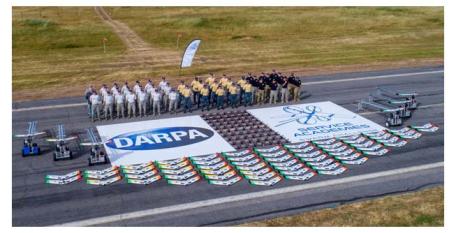
To help make effective swarm tactics with small unmanned aerial vehicles (UAVs) and other robots a reality, DARPA planned and organized the Service Academies Swarm Challenge, a collaboration between the Agency and the three U.S. military Service academies — the U.S. Military Academy, the U.S. Naval Academy, and the U.S. Air Force Academy.
An experiment at its heart, the research effort was designed to encourage students to develop innovative offensive and defensive tactics for swarms of small UAVs.
In April 2017, the Challenge culminated with a three-day Live-Fly Competition at Camp Roberts, a California Army National Guard post north of Paso Robles, California. There, more than 40 Cadets and Midshipmen demonstrated the highly autonomous swarm tactics they have developed since work started in September.
Over the course of the competition’s three days and three head-to-matches, the Navy team beat both the Army and the Air Force teams.
DARPA’s interest in developing breakthrough swarm capabilities for national security extends beyond the Swarm Challenge to a number of current programs exploring autonomy, communications, and other technologies, including:
Redefining Possible
Since 1958, DARPA has been an engine of innovation serving national defense and the U.S. warfighter.
A fourth-year capstone design course, the Swarm Challenge has pushed students to achieve “zero to swarm in eight months.” The goal: help the academies go from having little swarm-related expertise to developing capabilities with potentially near-term applicability for operational training and fielding—all within one academic year.
While people often think about swarms as simply being large collections of robots, swarms in fact have five defining characteristics: number, agent complexity, collective complexity, heterogeneity, and human-swarm interaction.