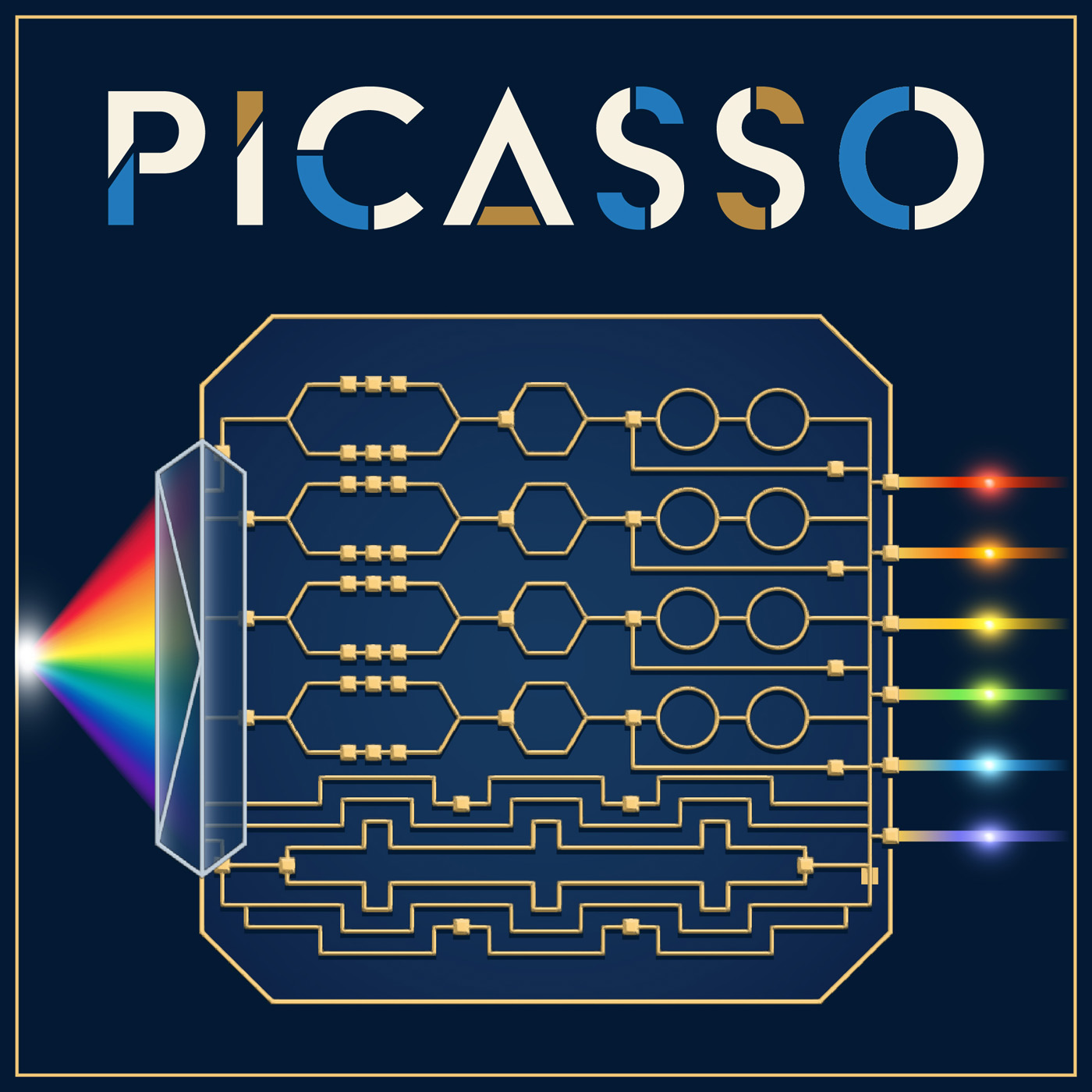
What are Photonic Integrated Circuit Architectures?
The aim of the Photonic Integrated Circuit Architectures for Scalable System Objectives (PICASSO) program is to revolutionize photonic integrated circuit architectures.
PICASSO seeks to expand the field’s focus from individual components to include a more holistic, circuit- and system-level orientation. This will lay the foundations for very large-scale photonic integration (VLPI), catalyzing future photonic capabilities by enabling functional expansion with predictable, system-level performance.
Scaling photonic circuits is challenged by the fundamental physics of signaling with light. As optical signals traverse long processing chains, they inevitably degrade and accumulate noise that simple amplification cannot fix.
Signal fidelity is also highly sensitive to spurious wave interactions such as scattering and back-reflections, which become unmanageable in large systems. While today’s systems mitigate these issues by converting light to electricity, this workaround negates the latency, efficiency, and bandwidth advantages inherent to photonics.
PICASSO confronts these challenges by embracing a new paradigm: creating tomorrow’s photonic circuits using today’s components.
Drawing inspiration from modern electronics, in which clever circuit design overcomes the limitations of individual transistors, the program will foster innovative circuit-level strategies to achieve unprecedented system performance and stability.