Explore by Tag
Explore by Tag
X
  • Access
  • Adaptability
  • Administration
  • Agency
  • AI
  • Air
  • Algorithms
  • Analytics
  • Automation
  • Autonomy
  • Bio-complexity
  • Bio-systems
  • BMC2
  • CBRN
  • Chemistry
  • Communications
  • Complexity
  • Contracts
  • Cost
  • Countermeasures
  • Cyber
  • Data
  • Decentralization
  • Disease
  • Electronics
  • Energy
  • Events
  • EW
  • Finance
  • Forecasting
  • Formal
  • Fundamentals
  • Games
  • Globalization
  • Ground
  • Health
  • History
  • Imagery
  • Injury
  • Integration
  • Interface
  • ISR
  • Language
  • Launch
  • Leadership
  • Logistics
  • Manufacturing
  • Maritime
  • Materials
  • Math
  • Med-Devices
  • Microchips
  • Microstructures
  • Microsystems
  • Mobile
  • Munitions
  • Networking
  • Neuroscience
  • Opportunities
  • Photonics
  • PNT
  • Policy
  • Privacy
  • Processing
  • Programming
  • Quantum
  • Resilience
  • Restoration
  • Robotics
  • Satellites
  • SBIR
  • Security
  • Sensors
  • Space
  • Spectroscopy
  • Spectrum
  • SWAP
  • Syn-Bio
  • Systems
  • Targeting
  • Tech-Foundations
  • Testimony
  • Therapy
  • Thermal
  • Training
  • Transition
  • Trust
  • Unmanned
  • Visualization
Defense Advanced
Research Projects Agency
Main Menu
X
  • About Us
    • About DARPA
    • People
    • Offices
    • Innovation Timeline
    • Testimony
    • Budget
    • Image Gallery
  • /
  • Our Research
  • /
  • News
  • /
  • Events
  • /
  • Work With Us
    • Opportunities
    • New Program Managers
    • Contract Management
    • For Industry
    • For Small Businesses
    • For Universities
    • For Government and Military
    • Employment at DARPA
    • Visitor Information
  • /
  • Search
Main Menu Explore by Tag
Defense Advanced Research Projects AgencyProgram Information

Gremlins

Mr. Scott Wierzbanowski

Gremlins

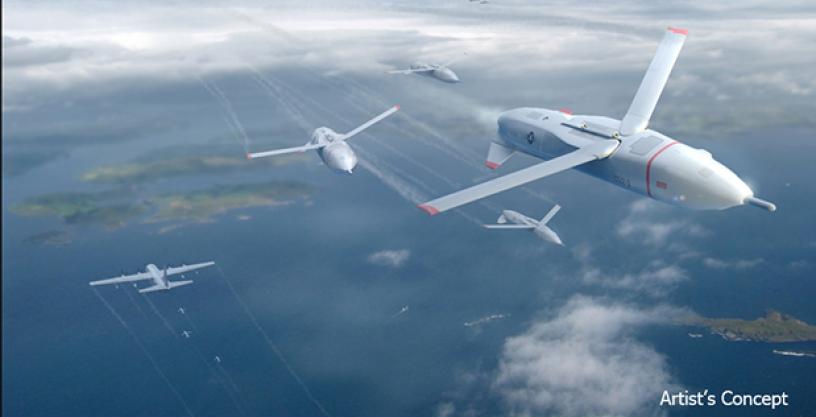
For decades, U.S. military air operations have relied on increasingly capable multi-function manned aircraft to execute critical combat and non-combat missions. Adversaries’ abilities to detect and engage those aircraft from longer ranges have improved over time as well, however, driving up the costs for vehicle design, operation and replacement. An ability to send large numbers of small unmanned air systems (UASs) with coordinated, distributed capabilities could provide U.S. forces with improved operational flexibility at much lower cost than is possible with today’s expensive, all-in-one platforms—especially if those unmanned systems could be retrieved for reuse while airborne. So far, however, the technology to project volleys of low-cost, reusable systems over great distances and retrieve them in mid-air has remained out of reach.

To help make that technology a reality, DARPA has launched the Gremlins program. Named for the imaginary, mischievous imps that became the good luck charms of many British pilots during World War II, the program envisions launching groups of UASs from existing large aircraft such as bombers or transport aircraft—as well as from fighters and other small, fixed-wing platforms—while those planes are out of range of adversary defenses. When the gremlins complete their mission, a C-130 transport aircraft would retrieve them in the air and carry them home, where ground crews would prepare them for their next use within 24 hours.

The gremlins’ expected lifetime of about 20 uses could provide significant cost advantages over expendable systems by reducing payload and airframe costs and by having lower mission and maintenance costs than conventional platforms, which are designed to operate for decades.

The Gremlins program plans to explore numerous technical areas, including:

  • Launch and recovery techniques, equipment and aircraft integration concepts
  • Low-cost, limited-life airframe designs
  • High-fidelity analysis, precision digital flight control, relative navigation and station keeping

The program aims to conduct a compelling proof-of-concept flight demonstration that could employ intelligence, surveillance, and reconnaissance (ISR) and other modular, non-kinetic payloads in a robust, responsive, and affordable manner.

Tags

| Air | Communications | Networking | Targeting |


Similarly    Tagged    Content

Gremlins Program Completes First Flight Test for X-61A Vehicle
Gremlins on Track for Demonstration Flights in 2019
Progress Toward an Ability to Recover Unmanned Aerial Vehicles on the Fly
Gremlins Takes Flight to Provide Air-Recoverable Unmanned Air Systems
PCAS Prototype Completes Successful Tests on A-10 Thunderbolt II Fighter

Images

  • Gremlins
    Gremlins
Back To Top

  • Print


Selected DARPA Achievements

DARPA collaborated with industry on stealth technology.
DARPA’s Stealth Revolution
In the early days of DARPA’s work on stealth technology, Have Blue, a prototype of what would become the F-117A, first flew successfully in 1977. The success of the F-117A program marked the beginning of the stealth revolution, which has had enormous benefits for national security.
DARPA microelectronics gave rise to today's GPS devices.
Navigation in the Palm of Your Hand
Early GPS receivers were bulky, heavy devices. In 1983, DARPA set out to miniaturize them, leading to a much broader adoption of GPS capability.
First rough conceptual design of the ARPANET.
Paving the Way to the Modern Internet
ARPA research played a central role in launching the Information Revolution. The agency developed and furthered much of the conceptual basis for the ARPANET—prototypical communications network launched nearly half a century ago—and invented the digital protocols that gave birth to the Internet.
  • About Us
  • About DARPA
  • People
  • Offices
  • Innovation Timeline
  • Testimony
  • Budget
  • History list page
  • Image Gallery
  • Our Research
  • Open Catalog
  • News
  • Events
  • Work With Us
  • Opportunities
  • New Program Managers
  • Contract Management
  • For Industry
  • For Small Businesses
  • For Universities
  • For Government and Military
  • Employment at DARPA
  • Site Info
  • Sitemap
  • Cookie Disclaimer
  • Web Policy
  • Privacy Policy
  • Accessibility/Section 508
  • No Fear Act
  • Whistleblower Protection Act
  • Usage Policy
  • DoD Hotline
  • USA.gov
  • /
  • Freedom of Information Act
  • /
  • Privacy and Civil Liberties
  • /
  • Visitor Information
  • /
  • Contact Us
  • Twitter
  • Facebook
  • YouTube
  • Instagram
  • Linked In
  • RSS
Defense Advanced Research Projects Agency 675 North Randolph Street
Arlington, VA 22203-2114
703.526.6630

This is an official U.S. Department of Defense website sponsored by the Defense Advanced Research Projects Agency.

You are now leaving the DARPA.mil website that is under the control and management of DARPA. The appearance of hyperlinks does not constitute endorsement by DARPA of non-U.S. Government sites or the information, products, or services contained therein. Although DARPA may or may not use these sites as additional distribution channels for Department of Defense information, it does not exercise editorial control over all of the information that you may find at these locations. Such links are provided consistent with the stated purpose of this website.


After reading this message, click  to continue immediately.

Go Back