Explore by Tag
Explore by Tag
X
  • Access
  • Adaptability
  • Administration
  • Agency
  • AI
  • Air
  • Algorithms
  • Analytics
  • Automation
  • Autonomy
  • Bio-complexity
  • Bio-systems
  • BMC2
  • CBRN
  • Chemistry
  • Communications
  • Complexity
  • Contracts
  • Cost
  • Countermeasures
  • Cyber
  • Data
  • Decentralization
  • Disease
  • Electronics
  • Energy
  • Events
  • EW
  • Finance
  • Forecasting
  • Formal
  • Fundamentals
  • Games
  • Globalization
  • Ground
  • Health
  • History
  • Imagery
  • Injury
  • Integration
  • Interface
  • ISR
  • Language
  • Launch
  • Leadership
  • Logistics
  • Manufacturing
  • Maritime
  • Materials
  • Math
  • Med-Devices
  • Microchips
  • Microstructures
  • Microsystems
  • Mobile
  • Munitions
  • Networking
  • Neuroscience
  • Opportunities
  • Photonics
  • PNT
  • Policy
  • Privacy
  • Processing
  • Programming
  • Quantum
  • Resilience
  • Restoration
  • Robotics
  • Satellites
  • SBIR
  • Security
  • Sensors
  • Space
  • Spectroscopy
  • Spectrum
  • SWAP
  • Syn-Bio
  • Systems
  • Targeting
  • Tech-Foundations
  • Testimony
  • Therapy
  • Thermal
  • Training
  • Transition
  • Trust
  • Unmanned
  • Visualization
Defense Advanced
Research Projects Agency
Main Menu
X
  • About Us
    • About DARPA
    • People
    • Offices
    • Testimony
    • Budget
    • DARPA History
    • Image Gallery
  • /
  • Our Research
  • /
  • News
  • /
  • Events
  • /
  • Work With Us
    • Opportunities
    • New Program Managers
    • Contract Management
    • For Industry
    • For Small Businesses
    • For Universities
    • For Government and Military
    • Employment at DARPA
    • Visitor Information
  • /
  • Search
Main Menu Explore by Tag
Defense Advanced Research Projects AgencyProgram Information

Data-Driven Discovery of Models (D3M)

Mr. Wade Shen

Data-Driven Discovery of Models (D3M)

Understanding the complex and increasingly data-intensive world around us relies on the construction of robust empirical models, i.e., representations of real, complex systems that enable decision makers to predict behaviors and answer “what-if” questions. Today, construction of complex empirical models is largely a manual process requiring a team of subject matter experts and data scientists. With ever more data becoming available via improved sensing and open sources, the opportunity exists to build models to speed scientific discovery, enhance Department of Defense/Intelligence Community’s intelligence, and improve United States Government logistics and workforce management, but capitalizing on this opportunity is fundamentally limited by the availability of data scientists.

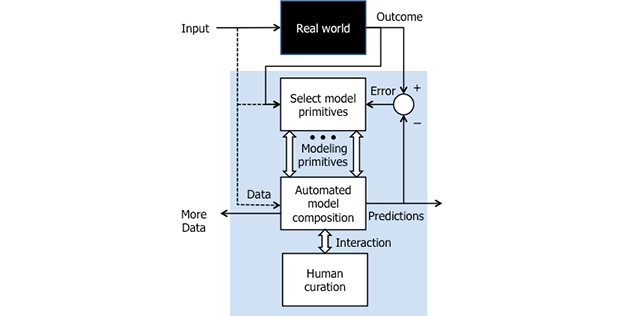
The Data-Driven Discovery of Models (D3M) program aims to develop automated model discovery systems that enable users with subject matter expertise but no data science background to create empirical models of real, complex processes. This capability will enable subject matter experts to create empirical models without the need for data scientists, and will increase the productivity of expert data scientists via automation. The D3M automated model discovery process, depicted in the figure, will be enabled by three key technologies to be developed in the course of the program:

  • A library of selectable primitives. A discoverable archive of data modeling primitives will be developed to serve as the basic building blocks for complex modeling pipelines.
  • Automated composition of complex models. Techniques will be developed for automatically selecting model primitives and for composing selected primitives into complex modeling pipelines based on user-specified data and outcome(s) of interest.
  • Human-model interaction that enables curation of models by subject matter experts. A method and interface will be developed to facilitate human-model interaction that enables formal definition of modeling problems and curation of automatically constructed models by users who are not data scientists.

Automated model discovery systems developed by the D3M program will be tested on real-world problems that will progressively get harder during the course of the program. Toward the end of the program, D3M will target problems that are both unsolved and underspecified in terms of data and instances of outcomes available for modeling.

Tags

| Analytics | Automation | Data |


Similarly    Tagged    Content

DARPA Goes “Meta” with Machine Learning for Machine Learning
Dr. David Doermann
Mr. Ian Crone
Hierarchical Identify Verify Exploit (HIVE) Proposers Day
Harnessing Commercially Available Geospatial Imagery for Defense Analysis
Back To Top

  • Print


Selected DARPA Achievements

DARPA collaborated with industry on stealth technology.
DARPA’s Stealth Revolution
In the early days of DARPA’s work on stealth technology, Have Blue, a prototype of what would become the F-117A, first flew successfully in 1977. The success of the F-117A program marked the beginning of the stealth revolution, which has had enormous benefits for national security.
DARPA microelectronics gave rise to today's GPS devices.
Navigation in the Palm of Your Hand
Early GPS receivers were bulky, heavy devices. In 1983, DARPA set out to miniaturize them, leading to a much broader adoption of GPS capability.
First rough conceptual design of the ARPANET.
Paving the Way to the Modern Internet
ARPA research played a central role in launching the Information Revolution. The agency developed and furthered much of the conceptual basis for the ARPANET—prototypical communications network launched nearly half a century ago—and invented the digital protocols that gave birth to the Internet.
  • About Us
  • About DARPA
  • People
  • Offices
  • Testimony
  • Budget
  • DARPA History
  • Image Gallery
  • Our Research
  • Open Catalog
  • News
  • Events
  • Work With Us
  • Opportunities
  • New Program Managers
  • Contract Management
  • For Industry
  • For Small Businesses
  • For Universities
  • For Government and Military
  • Employment at DARPA
  • Site Info
  • Sitemap
  • Cookie Disclaimer
  • Web Policy
  • Privacy Policy
  • Accessibility/Section 508
  • No Fear Act
  • Usage Policy
  • USA.gov
  • /
  • Freedom of Information Act
  • /
  • Visitor Information
  • /
  • Contact Us
  • Twitter
  • Facebook
  • Goolge+
  • YouTube
  • RSS
Defense Advanced Research Projects Agency 675 North Randolph Street
Arlington, VA 22203-2114
703.526.6630

This is an official U.S. Department of Defense website sponsored by the Defense Advanced Research Projects Agency.

You are now leaving the DARPA.mil website that is under the control and management of DARPA. The appearance of hyperlinks does not constitute endorsement by DARPA of non-U.S. Government sites or the information, products, or services contained therein. Although DARPA may or may not use these sites as additional distribution channels for Department of Defense information, it does not exercise editorial control over all of the information that you may find at these locations. Such links are provided consistent with the stated purpose of this website.


After reading this message, click  to continue immediately.

Go Back