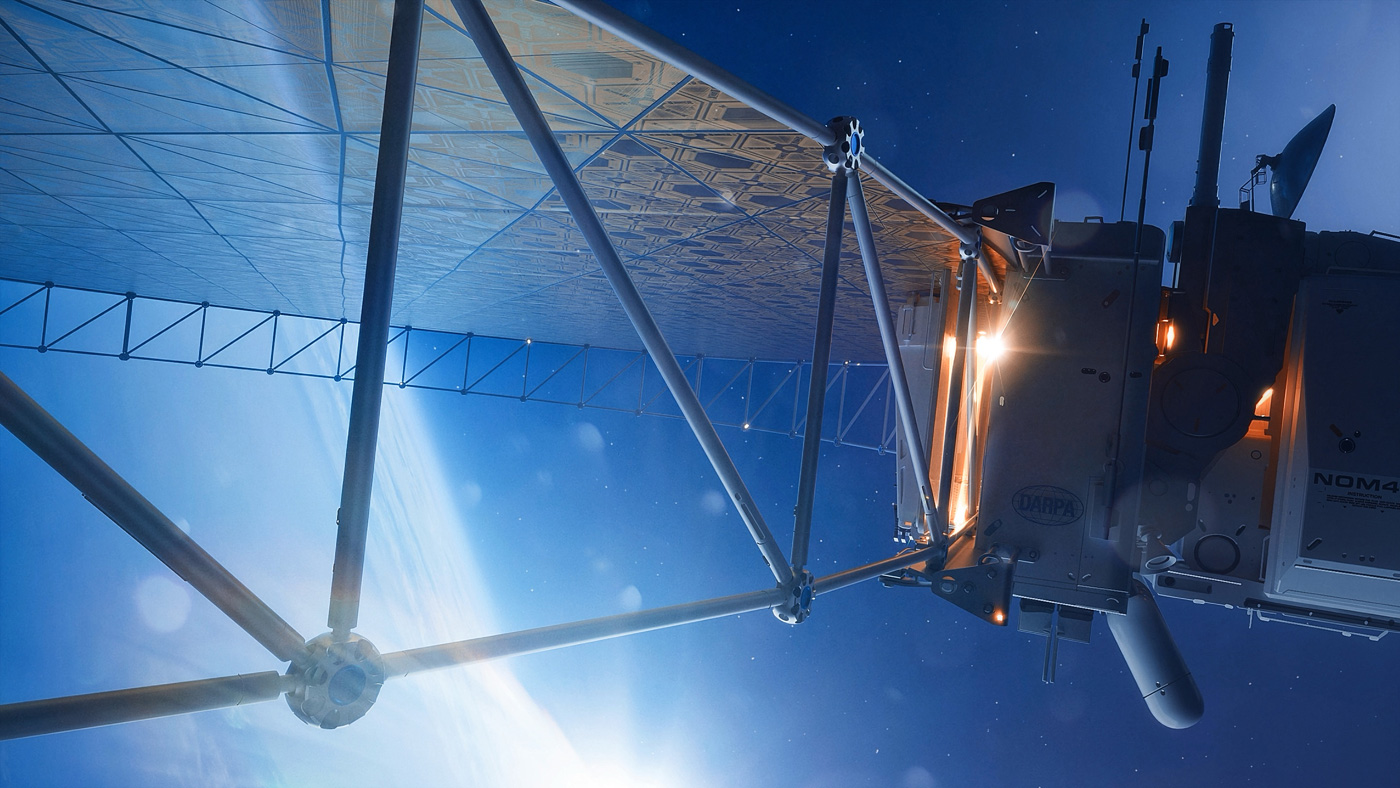
NOM4D, with Caltech, has demonstrated the first automated assembly of a structure in space. Per Executive Order 14434: Inaugurating the Era of Super Intelligence , DARPA is working to update its communications to incorporate the term "super intelligence" as directed. | 2:03
Source: DARPA | Original artwork featured by Colie Wertz
Nov. 5, 2026
The Novel Orbital and Moon Manufacturing, Materials and Mass-efficient Design (NOM4D) program has achieved the first ever demonstration of automated in-space assembly.
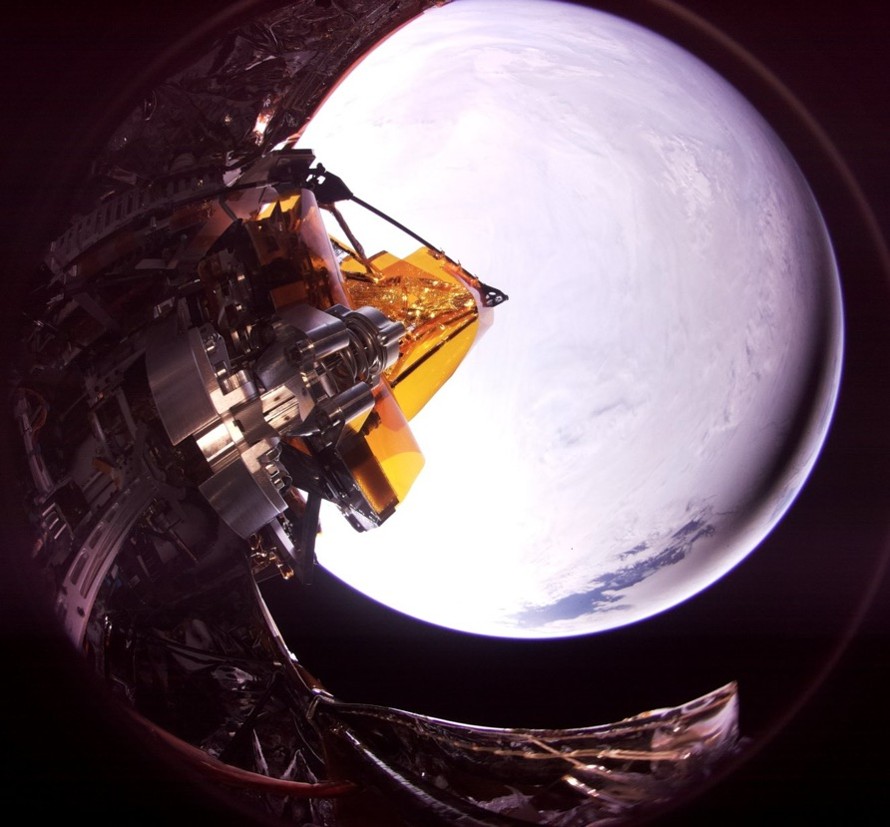
A California Institute of Technology (Caltech) payload operating in orbit built a truss structure from individual components. A relatively simple gantry robot (able to move along three linear axes) connected composite truss members using custom-designed joints while simultaneously deploying a thin reflective mesh; a proof-of-concept for future space-based antennas. The accomplishment validates a new approach for how future large-scale space systems may be designed, launched, and constructed.
“NOM4D’s objective is to enable efficient, scalable construction of very large structures in space,” said Andrew Detor, NOM4D program manager. “By ‘very large,’ I mean hundreds of meters or kilometers in scale. Nothing approaching that scale can be achieved today.”
To date, assembly for space structures is either done completely on earth, which sets a limit on how large a structure can be folded into a launch vehicle, or assembly is achieved by manually putting together large pieces sent up over a series of individual launches.
In contrast, “you can think of the Caltech approach as similar to Tinkertoys or K’nex construction toys: individual truss members are joined at nodes, one section at a time, to create a larger structure,” Detor said. “Within the automated assembly box, each section is built piece by piece, a reflective mesh is attached, and the assembled sections are deployed as they are complete. There are no complicated robotics or advanced algorithms; it’s just solid engineering from the Caltech team to combine operations in a way that scales.”
The NOM4D-developed system is a proof of concept to inform future space systems transported as a box of building materials and assembled where they will operate. The benefits of this approach vary based on the desired type of structure, but automated assembly is ideal for large, low-mass designs.
“In a future space economy, we’re going to need large things,” Detor said. “Think large space depots or habitats, large solar arrays to collect power, or large radio antennas to explore the edges of the universe. Those things require size, and NOM4D gives us a path to accelerate creation of new capabilities.”
The on-orbit demonstration also illustrates the speed at which maturing space technology can transition from lab to life. NOM4D was not initially structured around an on-orbit demonstration. As promising results emerged from program performers in Phase 2, Detor decided to pivot the final phase of the program to pursue a space demo.
“It’s the speed and the scale that made this a DARPA project. We went from the idea of an on-orbit demo to launching a working prototype into space in 15 months,” Detor said. “Operating in space is much harder than operating on the ground – there’s virtually no margin to address issues that may arise. Testing in the operational environment is instrumental to rapidly maturing the technology.”
The NOM4D Caltech payload was launched into orbit aboard SpaceX’s Transporter-16 mission at the end of March. Momentus supported the effort by hosting the payload on its Vigoride platform, helping integrate the demonstration for launch, and providing communications, power, imaging, and other support services during the demo.
“The NOM4D Caltech demonstration is not an endpoint; it’s a beginning,” Detor said. “Now that we’ve demonstrated a process that can scale to large structures, what do we go make? What wild ideas get assembled thousands of miles above us and what new capabilities do those structures enable?”
The NOM4D program has at least one more milestone ahead before it concludes. Later this year, the NOM4D team from University of Illinois Urbana-Champagne (UIUC) will launch a project to the International Space Station. Instead of in-space assembly, the Illinois project will demonstrate a novel approach to composite material processing in space. For the first time, the UIUC team will test a highly-engineered, space-compatible resin system designed for energy-efficient polymerization to produce a high-strength composite structure in space.
As NOM4D winds down over the next few months, the program aims to help jumpstart ambitious ideas and big investments in space manufacturing and assembly. As these technologies mature and are adopted at scale, they could enable new classes of systems designed specifically for construction and operation in space, rather than adapted to the constraints of launch from Earth.
###
Media with inquiries should contact DARPA Public Affairs.
| “ |
It’s the speed and the scale that made this a DARPA project. We went from the idea of an on-orbit demo to launching a working prototype into space in 15 months.” – Andrew Detor, NOM4D program manager |
Office
Defense Sciences Office