


DARPA program seeks to provide commanders with “insider” knowledge of local environments
Jan. 30, 2020
U.S. forces operating in remote, under-governed regions around the world often find that an area’s distinct cultural and societal practices are opaque to outsiders, but are obvious to locals. Commanders can be hindered from making optimal decisions because they lack knowledge of how local socio-economic, political, religious, health, and infrastructure factors interact to shape a specific community.
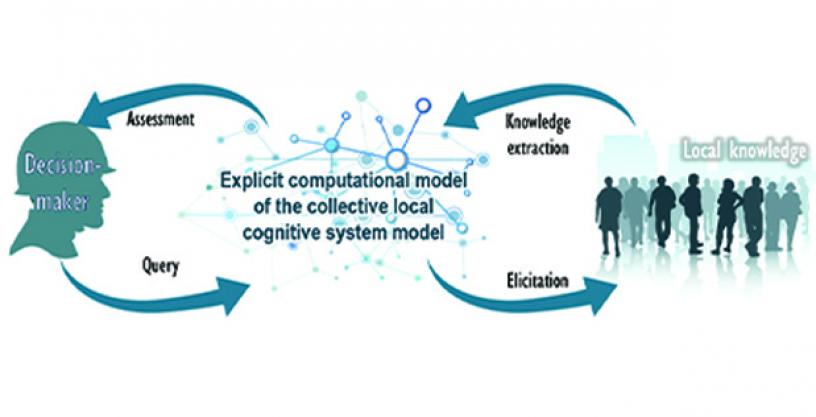
To overcome this challenge, DARPA is launching the Habitus program, which seeks to capture and make local knowledge available to military operators, providing them with an insider’s view to support sound decision-making. The program aims to develop new engagement mechanisms and methodologies for creating predictive, causal models of local systems based on input from locals. The resulting capability aims to be generalizable across regions and populations, adaptive as societies change over time, and self-sustaining for maintainability and persistence.
“Habitus is about making implicit knowledge explicit,” said Bart Russell, program manager in DARPA’s Defense Sciences Office. “We want to develop models and local engagement mechanisms that reveal what factors are most important in a given location to help us better anticipate the outcomes of our actions in supporting stability. Even more importantly, we want to discover factors that locals think are important but that outsiders don’t know to ask about in the first place. How do you discover those factors? How do you go in and not impose a very westernized, academic approach to understanding a socioeconomic system that incorporates both concrete factors and cultural factors that are traditionally very hard to quantify?”
Russell cites the Ebola outbreak in West Africa from 2014-2016 as an example of outsiders lacking knowledge of critical local factors affecting a rapidly changing, life-and-death situation. Response teams focused mostly on health issues in the community but not on traditional burial practices where family members touch and wash bodies of the deceased, thus increasing their likelihood of contracting the deadly disease. An earlier awareness of this cultural factor’s significance could have led to interventions to slow the spread of Ebola.
The Habitus system aims to be:
- Adaptive, so system representations and projections stay current and accurate as human systems change over time;
- Scalable and generalizable, so that the methodology readily transfers to new regions, populations, and topics;
- Self-sustaining, meaning it requires few resources to maintain over time; and
- Specific and detailed enough to provide causal insight.
Current methods for accessing local knowledge include subject matter experts, big data, and polling, which are valuable tools, but no single method is generalizable, adaptive, self-sustaining, and specific.
“The big data approaches have been fabulous for making a lot of data available to us,” Russell said. “But we are not understanding the data through the local lens from which it was generated, which is a big problem. We need to think differently about how to tackle this challenge.”
Personal outreach to local leaders is important and helpful to commanders, but it’s not generalizable to other locations and regions.
“It’s not feasible or sustainable to pay for subject matter experts to talk to every local community in vastly different regions of the world,” Russell said. “Habitus will require development of foundational science for creating explicit, local cognitive models and then scale them to be easily adaptable to other settings.”
The program encompasses two technical areas, model development and engagement mechanisms. Model development will involve locally specific model creation that, through unbiased, semi-automated elicitation and knowledge extraction is scalable and generalizable. The engagement mechanism technical area aims to develop self-sustaining methods for gathering the necessary data in an ongoing manner to enable adaptability.
One example of an existing engagement mechanism that is self-sustaining and adaptable is the smartphone app, AfriScout, Russell said. AfriScout enables farmers in Africa to see the current status of watering locations and grazing lands for their herds, significantly reducing time and effort looking for pastureland or water. The app is also adaptable, being used to highlight other important information such as dangerous locations where violence has been reported.
Russell hopes proposers will reach out to non-governmental organizations (NGOs) who are already investigating similar innovative, sustainable engagement mechanisms to see how additional features potentially could be incorporated.
A Proposers Day is scheduled for Feb. 10, 2020 in Arlington, Virginia, which will also be webcast. The following link provides details: https://go.usa.gov/xdbHT. A Broad Agency Announcement solicitation with full program information is expected by the end of February and will be posted on SAM.gov.
Photo caption: This graphic depicts the Habitus program concept. The term Habitus comes from 20th Century French sociologist Pierre Bourdieu who defined it as “…an expression of an individual’s social and cultural history which attempts to link lived experience to action.”
# # #
Media with inquiries should contact DARPA Public Affairs at outreach@darpa.mil
Associated images posted on www.darpa.mil and video posted at www.youtube.com/darpatv may be reused according to the terms of the DARPA User Agreement, available here: http://go.usa.gov/cuTXR.
Tweet @darpa