Explore by Tag
Explore by Tag
X
  • Access
  • Adaptability
  • Administration
  • Agency
  • AI
  • Air
  • Algorithms
  • Analytics
  • Automation
  • Autonomy
  • Bio-complexity
  • Bio-systems
  • BMC2
  • CBRN
  • Chemistry
  • Communications
  • Complexity
  • Contracts
  • Cost
  • Countermeasures
  • Cyber
  • Data
  • Decentralization
  • Disease
  • Electronics
  • Energy
  • Events
  • EW
  • Finance
  • Forecasting
  • Formal
  • Fundamentals
  • Games
  • Globalization
  • Ground
  • Health
  • History
  • Imagery
  • Injury
  • Integration
  • Interface
  • ISR
  • Language
  • Launch
  • Leadership
  • Logistics
  • Manufacturing
  • Maritime
  • Materials
  • Math
  • Med-Devices
  • Microchips
  • Microstructures
  • Microsystems
  • Mobile
  • Munitions
  • Networking
  • Neuroscience
  • Opportunities
  • Photonics
  • PNT
  • Policy
  • Privacy
  • Processing
  • Programming
  • Quantum
  • Resilience
  • Restoration
  • Robotics
  • Satellites
  • SBIR
  • Security
  • Sensors
  • Space
  • Spectroscopy
  • Spectrum
  • SWAP
  • Syn-Bio
  • Systems
  • Targeting
  • Tech-Foundations
  • Testimony
  • Therapy
  • Thermal
  • Training
  • Transition
  • Trust
  • Unmanned
  • Visualization
Defense Advanced
Research Projects Agency
Main Menu
X
  • About Us
    • About DARPA
    • People
    • Offices
    • Innovation Timeline
    • Testimony
    • Budget
    • Image Gallery
  • /
  • Our Research
  • /
  • News
  • /
  • Events
  • /
  • Work With Us
    • Opportunities
    • New Program Managers
    • Contract Management
    • For Industry
    • For Small Businesses
    • For Universities
    • For Government and Military
    • Employment at DARPA
    • Visitor Information
  • /
  • Search
Main Menu Explore by Tag
Defense Advanced Research Projects AgencyNews And Events

Drinking Water, on Demand and from Air

Low-power extraction technologies could capture potable water from ambient arid air, giving deployed troops greater mission flexibility

outreach@darpa.mil
12/12/2019
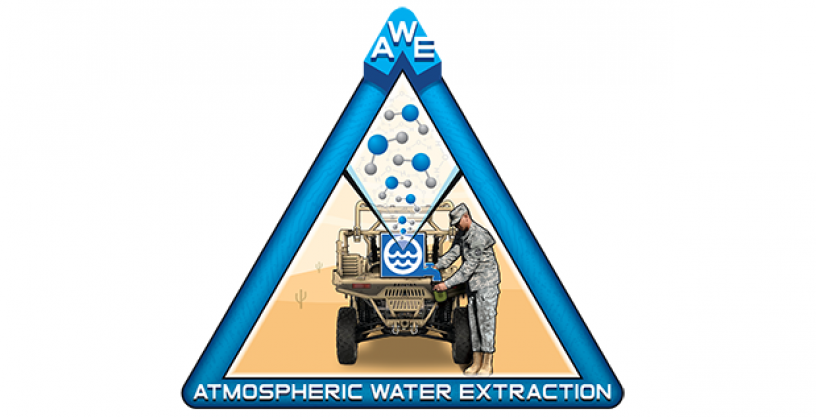
Atmospheric Water Extraction (AWE)

Providing potable drinking water to deployed troops operating in low resource or contested environments is no simple undertaking. Logistics teams face great risk delivering water and often incur what would otherwise be preventable casualties. DARPA’s new Atmospheric Water Extraction (AWE) program sets out to sharply reduce that risk by giving deployed units the technology to capture potable water on the spot from the air in quantities sufficient to meet daily needs of the warfighter, even in extremely dry areas of the world.

“The demand for drinking water is a constant across all Department of Defense missions, and the risk, cost, and complexity that go into meeting that demand can quickly become force limiting factors,” said Seth Cohen, the AWE program manager. “Right now, the military relies on purification of regional fresh and saline water sources, or transported bottled water, neither of which are optimal for mobile forces that operate with a small footprint. DARPA is turning to atmospheric water extraction as a potential solution that offers maximal operational flexibility with minimal risk.”

The AWE program has two tracks. Researchers supporting the Expeditionary Track will target deliverables built around the daily potable water requirement for an individual, in a compact, portable form factor. Researchers on the Stabilization Track will develop technology that is transportable on a standard military vehicle and can support a company of up to 150 people.

DARPA is open to various approaches, with an emphasis on advanced sorbents that can rapidly extract water from ambient air and release it quickly with minimal energy inputs. These sorbent materials offer potential solutions to the AWE challenge, provided they can be produced at the necessary scale and remain stable over thousands of extraction cycles. In addition to developing new sorbents, AWE researchers will need to engineer systems to optimize their suitability for highly mobile forces by substantially reducing the size, weight, and power requirements compared to existing technologies.

“If the AWE program succeeds in providing troops with potable water even in arid climates, that gives commanders greater maneuver and decision space and allows operations to run longer,” said Cohen. “Ultimately, the technology could even diminish the motivation for conflicts over resources by providing a new source of drinking water to stressed populations.”

DARPA is hosting a Proposers Day meeting on January 7, 2020, in Arlington, Virginia, to provide more information about AWE to interested researchers. Find out more at https://beta.sam.gov/opp/d18336caf5734f09bccc426fa4cb01a2/view.

A forthcoming Broad Agency Announcement will include full program details. It will be posted to https://go.usa.gov/xp8UZ.


# # #


Media with inquiries should contact DARPA Public Affairs at outreach@darpa.mil


Associated images posted on www.darpa.mil and video posted at www.youtube.com/darpatv may be reused according to the terms of the DARPA User Agreement, available here: http://go.usa.gov/cuTXR.


Tweet @darpa


Tags

| Bio-systems | Health | Materials | SWAP |


Similarly    Tagged    Content

Detect It with Gene Editing Technologies (DIGET) Proposers Day
Personalized Protective Biosystem (PPB) Proposers Day (Archived)
PReemptive Expression of Protective Alleles and Response Elements (PREPARE) Proposers Day
Young Faculty Award (YFA) Program Proposers Day
Gene Editors Could Find New Use as Rapid Detectors of Pathogenic Threats

Images

  • Atmospheric Water Extraction (AWE)
    Atmospheric Water Extraction (AWE)
Back To Top

  • Print


Selected DARPA Achievements

DARPA collaborated with industry on stealth technology.
DARPA’s Stealth Revolution
In the early days of DARPA’s work on stealth technology, Have Blue, a prototype of what would become the F-117A, first flew successfully in 1977. The success of the F-117A program marked the beginning of the stealth revolution, which has had enormous benefits for national security.
DARPA microelectronics gave rise to today's GPS devices.
Navigation in the Palm of Your Hand
Early GPS receivers were bulky, heavy devices. In 1983, DARPA set out to miniaturize them, leading to a much broader adoption of GPS capability.
First rough conceptual design of the ARPANET.
Paving the Way to the Modern Internet
ARPA research played a central role in launching the Information Revolution. The agency developed and furthered much of the conceptual basis for the ARPANET—prototypical communications network launched nearly half a century ago—and invented the digital protocols that gave birth to the Internet.
  • About Us
  • About DARPA
  • People
  • Offices
  • Innovation Timeline
  • Testimony
  • Budget
  • History list page
  • Image Gallery
  • Our Research
  • Open Catalog
  • News
  • Events
  • Work With Us
  • Opportunities
  • New Program Managers
  • Contract Management
  • For Industry
  • For Small Businesses
  • For Universities
  • For Government and Military
  • Employment at DARPA
  • Site Info
  • Sitemap
  • Cookie Disclaimer
  • Web Policy
  • Privacy Policy
  • Accessibility/Section 508
  • No Fear Act
  • Whistleblower Protection Act
  • Usage Policy
  • DoD Hotline
  • USA.gov
  • /
  • Freedom of Information Act
  • /
  • Privacy and Civil Liberties
  • /
  • Visitor Information
  • /
  • Contact Us
  • Twitter
  • Facebook
  • YouTube
  • Instagram
  • Linked In
  • RSS
Defense Advanced Research Projects Agency 675 North Randolph Street
Arlington, VA 22203-2114
703.526.6630

This is an official U.S. Department of Defense website sponsored by the Defense Advanced Research Projects Agency.

You are now leaving the DARPA.mil website that is under the control and management of DARPA. The appearance of hyperlinks does not constitute endorsement by DARPA of non-U.S. Government sites or the information, products, or services contained therein. Although DARPA may or may not use these sites as additional distribution channels for Department of Defense information, it does not exercise editorial control over all of the information that you may find at these locations. Such links are provided consistent with the stated purpose of this website.


After reading this message, click  to continue immediately.

Go Back