Explore by Tag
Explore by Tag
X
  • Access
  • Adaptability
  • Administration
  • Agency
  • AI
  • Air
  • Algorithms
  • Analytics
  • Automation
  • Autonomy
  • Bio-complexity
  • Bio-systems
  • BMC2
  • CBRN
  • Chemistry
  • Communications
  • Complexity
  • Contracts
  • Cost
  • Countermeasures
  • Cyber
  • Data
  • Decentralization
  • Disease
  • Electronics
  • Energy
  • Events
  • EW
  • Finance
  • Forecasting
  • Formal
  • Fundamentals
  • Games
  • Globalization
  • Ground
  • Health
  • History
  • Imagery
  • Injury
  • Integration
  • Interface
  • ISR
  • Language
  • Launch
  • Leadership
  • Logistics
  • Manufacturing
  • Maritime
  • Materials
  • Math
  • Med-Devices
  • Microchips
  • Microstructures
  • Microsystems
  • Mobile
  • Munitions
  • Networking
  • Neuroscience
  • Opportunities
  • Photonics
  • PNT
  • Policy
  • Privacy
  • Processing
  • Programming
  • Quantum
  • Resilience
  • Restoration
  • Robotics
  • Satellites
  • SBIR
  • Security
  • Sensors
  • Space
  • Spectroscopy
  • Spectrum
  • SWAP
  • Syn-Bio
  • Systems
  • Targeting
  • Tech-Foundations
  • Testimony
  • Therapy
  • Thermal
  • Training
  • Transition
  • Trust
  • Unmanned
  • Visualization
Defense Advanced
Research Projects Agency
Main Menu
X
  • About Us
    • About DARPA
    • People
    • Offices
    • Innovation Timeline
    • Testimony
    • Budget
    • Image Gallery
  • /
  • Our Research
  • /
  • News
  • /
  • Events
  • /
  • Work With Us
    • Opportunities
    • New Program Managers
    • Contract Management
    • For Industry
    • For Small Businesses
    • For Universities
    • For Government and Military
    • Employment at DARPA
    • Visitor Information
  • /
  • Search
Main Menu Explore by Tag
Defense Advanced Research Projects AgencyNews And Events

Teams Complete SubT Challenge Virtual Tunnel Circuit

Coordinated Robotics earns top score, $500,000 in prizes shared among the top self-funded teams

outreach@darpa.mil
10/30/2019
SubT Challenge Virtual Tunnel Circuit

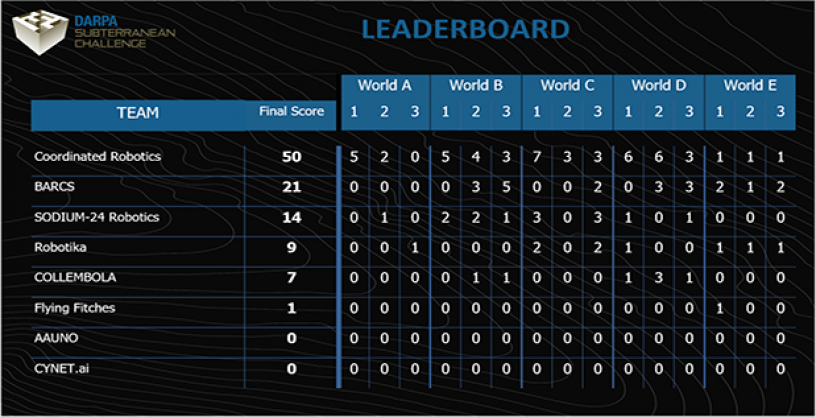
With 50 total points, Coordinated Robotics finished in first place in the DARPA Subterranean (SubT) Challenge Virtual Tunnel Circuit event, and as the top self-funded team, earned $250,000. Eight teams developed, tested, and submitted their software-based solutions for simulation-based evaluation on the SubT Virtual Testbed.

DARPA-funded and self-funded teams compete side-by-side throughout the Subterranean Challenge. Only self-funded teams are eligible for prizes in the Circuit Events, but they must finish in the top five overall. All qualified teams are eligible for prizes in the Final Event.

Bayesian Adaptive Robot Control System (BARCS) took second place. SODIUM-24 Robotics came in third, and as a self-funded team, earned the $150,000 prize. Robotika finished fourth, and as a self-funded team, earned the $100,000 prize. Communication Optimized, Low Latency Exploration, Map-Building and Object Localization Autonomy (COLLEMBOLA) rounded out the top five.

The Virtual Tunnel Circuit competitors developed advanced software for their respective teams of virtual aerial and wheeled robots to explore tunnel environments, with the goal of finding various artifacts hidden throughout the virtual environment and reporting their locations and types to within a five-meter radius during each 60-minute simulation run. Identical to the rules of the SubT Challenge Systems competition, a correct report is worth one point and competitors win by accruing the most points across multiple, diverse simulated environments.

Each team assembled a roster of robots and sensors by selecting from the available configurations on the SubT Tech Repo. Each robot configuration has an associated cost, measured in SubT Credits – an in-simulation currency – based on performance characteristics such as speed, mobility, sensing, and battery life. The team rosters are limited to a maximum combined cost of 1,000 SubT Credits.

Each team wrote software and algorithms for their set of robots to compete in the simulated environments. Several practice scenarios were available in advance for teams to test, refine, and perfect their innovative approaches, leading to their final submissions. DARPA evaluated each entry using a set of hidden competition scenarios of varying scales and difficulty levels.

"The Virtual Tunnel Circuit challenged teams to develop an even greater understanding of how autonomous systems will work with zero human intervention, i.e., no human supervisor, available to redirect or adjust course," said Timothy Chung, DARPA program manager for the Subterranean Challenge. "The Virtual courses, just like the Systems courses, intentionally mimic the unpredictability and diverse terrain that service members and first responders could encounter in unknown, underground environments."

The final scores were as follows:

  • Coordinated Robotics, self-funded: 50
    • Kevin Knoedler
  • BARCS, DARPA-funded: 21
    • Michigan Technological University/Michigan Tech Research Institute
  • SODIUM-24 Robotics, self-funded: 14
    • Malcolm Stagg
  • Robotika, self-funded: 9
    • Robotika International
    • Robotika.cz
    • Czech University of Life Science
    • Centre for Field Robotics
    • Cogito Team
  • COLLEMBOLA, DARPA-funded: 7
    • Scientific Systems Company, Inc.
  • Flying Fitches, self-funded: 1
    • Sophisticated Engineering UG
  • AAUNO, self-funded: 0
    • Kankanwadi
  • CYNET.ai, self-funded: 0
    • Jersey Media Network Corp.

The DARPA Subterranean Challenge seeks to better equip warfighters and first responders to explore human-made tunnel systems, urban underground, and natural cave networks, while decreasing risk to human lives. The SubT Challenge Systems and Virtual competitions aim to create a community of multidisciplinary teams from wide-ranging fields to foster breakthrough technologies in autonomy, perception, networking, and mobility for underground environments.

Researchers, engineers, roboticists, and robot enthusiasts inspired by the Tunnel Circuit still have time to apply to compete in either or both of the Urban Circuit Systems and Virtual competitions, which will take place in February 2020. The qualification deadline for the Systems Urban Circuit is Dec. 3, with a deadline of Jan, 3, 2020, for the Virtual competition. Qualification requirements and competition rules can be found on the Resources tab of the Subterranean Challenge website.

The Cave Circuit will take place in August 2020. The Final Event incorporating all three subdomains will be in August 2021.

Please email questions to SubTChallenge@darpa.mil.

Image Caption: Final leaderboard for Subterranean Challenge Virtual Tunnel Circuit

# # #


Media with inquiries should contact DARPA Public Affairs at outreach@darpa.mil


Associated images posted on www.darpa.mil and video posted at www.youtube.com/darpatv may be reused according to the terms of the DARPA User Agreement, available here: http://go.usa.gov/cuTXR.


Tweet @darpa


Tags

| Air | Autonomy | Ground | Interface | ISR | Opportunities | Robotics | Unmanned |


Similarly    Tagged    Content

SubT Challenge Proposers Day
Subterranean Challenge Competitors Day
Subterranean Challenge Tunnel Circuit
Subterranean Challenge Identifies Urban Circuit Location, Updates Prize Amounts
Rolling, Walking, Flying, and Floating, SubT Challenge Teams Traverse the Tunnel Circuit

Images

  • SubT Challenge Virtual Tunnel Circuit
    SubT Challenge Virtual Tunnel Circuit
Back To Top

  • Print


Selected DARPA Achievements

DARPA collaborated with industry on stealth technology.
DARPA’s Stealth Revolution
In the early days of DARPA’s work on stealth technology, Have Blue, a prototype of what would become the F-117A, first flew successfully in 1977. The success of the F-117A program marked the beginning of the stealth revolution, which has had enormous benefits for national security.
DARPA microelectronics gave rise to today's GPS devices.
Navigation in the Palm of Your Hand
Early GPS receivers were bulky, heavy devices. In 1983, DARPA set out to miniaturize them, leading to a much broader adoption of GPS capability.
First rough conceptual design of the ARPANET.
Paving the Way to the Modern Internet
ARPA research played a central role in launching the Information Revolution. The agency developed and furthered much of the conceptual basis for the ARPANET—prototypical communications network launched nearly half a century ago—and invented the digital protocols that gave birth to the Internet.
  • About Us
  • About DARPA
  • People
  • Offices
  • Innovation Timeline
  • Testimony
  • Budget
  • History list page
  • Image Gallery
  • Our Research
  • Open Catalog
  • News
  • Events
  • Work With Us
  • Opportunities
  • New Program Managers
  • Contract Management
  • For Industry
  • For Small Businesses
  • For Universities
  • For Government and Military
  • Employment at DARPA
  • Site Info
  • Sitemap
  • Cookie Disclaimer
  • Web Policy
  • Privacy Policy
  • Accessibility/Section 508
  • No Fear Act
  • Whistleblower Protection Act
  • Usage Policy
  • DoD Hotline
  • USA.gov
  • /
  • Freedom of Information Act
  • /
  • Privacy and Civil Liberties
  • /
  • Visitor Information
  • /
  • Contact Us
  • Twitter
  • Facebook
  • YouTube
  • Instagram
  • Linked In
  • RSS
Defense Advanced Research Projects Agency 675 North Randolph Street
Arlington, VA 22203-2114
703.526.6630

This is an official U.S. Department of Defense website sponsored by the Defense Advanced Research Projects Agency.

You are now leaving the DARPA.mil website that is under the control and management of DARPA. The appearance of hyperlinks does not constitute endorsement by DARPA of non-U.S. Government sites or the information, products, or services contained therein. Although DARPA may or may not use these sites as additional distribution channels for Department of Defense information, it does not exercise editorial control over all of the information that you may find at these locations. Such links are provided consistent with the stated purpose of this website.


After reading this message, click  to continue immediately.

Go Back