Explore by Tag
Explore by Tag
X
  • Access
  • Adaptability
  • Administration
  • Agency
  • AI
  • Air
  • Algorithms
  • Analytics
  • Automation
  • Autonomy
  • Bio-complexity
  • Bio-systems
  • BMC2
  • CBRN
  • Chemistry
  • Communications
  • Complexity
  • Contracts
  • Cost
  • Countermeasures
  • Cyber
  • Data
  • Decentralization
  • Disease
  • Electronics
  • Energy
  • Events
  • EW
  • Finance
  • Forecasting
  • Formal
  • Fundamentals
  • Games
  • Globalization
  • Ground
  • Health
  • History
  • Imagery
  • Injury
  • Integration
  • Interface
  • ISR
  • Language
  • Launch
  • Leadership
  • Logistics
  • Manufacturing
  • Maritime
  • Materials
  • Math
  • Med-Devices
  • Microchips
  • Microstructures
  • Microsystems
  • Mobile
  • Munitions
  • Networking
  • Neuroscience
  • Opportunities
  • Photonics
  • PNT
  • Policy
  • Privacy
  • Processing
  • Programming
  • Quantum
  • Resilience
  • Restoration
  • Robotics
  • Satellites
  • SBIR
  • Security
  • Sensors
  • Space
  • Spectroscopy
  • Spectrum
  • SWAP
  • Syn-Bio
  • Systems
  • Targeting
  • Tech-Foundations
  • Testimony
  • Therapy
  • Thermal
  • Training
  • Transition
  • Trust
  • Unmanned
  • Visualization
Defense Advanced
Research Projects Agency
Main Menu
X
  • About Us
    • About DARPA
    • People
    • Offices
    • Testimony
    • Budget
    • DARPA History
    • Image Gallery
  • /
  • Our Research
  • /
  • News
  • /
  • Events
  • /
  • Work With Us
    • Opportunities
    • New Program Managers
    • Contract Management
    • For Industry
    • For Small Businesses
    • For Universities
    • For Government and Military
    • Employment at DARPA
    • Visitor Information
  • /
  • Search
Main Menu Explore by Tag
Defense Advanced Research Projects AgencyNews And Events

DARPA Goes “Meta” with Machine Learning for Machine Learning

Data-Driven Discovery of Models (D3M) seeks to increase pace of scientific discovery and improve military planning, logistics and intelligence outcomes

outreach@darpa.mil
6/17/2016
Data-Driven Discovery of Models (D3M)

Popular search engines are great at finding answers for point-of-fact questions like the elevation of Mount Everest or current movies running at local theaters. They are not, however, very good at answering what-if or predictive questions—questions that depend on multiple variables, such as “What influences the stock market?” or “What are the major drivers of environmental stability?” In many cases that shortcoming is not for lack of relevant data. Rather, what’s missing are empirical models of complex processes that influence the behavior and impact of those data elements. In a world in which scientists, policymakers and others are awash in data, the inability to construct reliable models that can deliver insights from that raw information has become an acute limitation for planners.

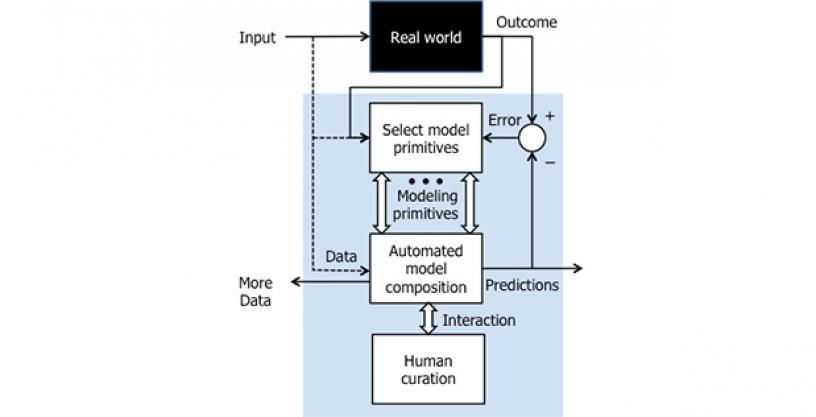
To free researchers from the tedium and limits of having to design their own empirical models, DARPA today launched its Data-Driven Discovery of Models (D3M) program. The goal of D3M is to help overcome the data-science expertise gap by enabling non-experts to construct complex empirical models through automation of large parts of the model-creation process. If successful, researchers using D3M tools will effectively have access to an army of “virtual data scientists.”

“The construction of empirical models today is largely a manual process, requiring data experts to translate stochastic elements, such as weather and traffic, into models that engineers and scientists can then ask questions of,” said Wade Shen, program manager in DARPA’s Information Innovation Office. “We have an urgent need to develop machine-based modeling for users with no data-science background. We believe it’s possible to automate certain aspects of data science, and specifically to have machines learn from prior example how to construct new models.”

D3M is being initiated at a time when there is unprecedented availability of data via improved sensing and open sources, and vast opportunities to take advantage of those data streams to speed scientific discovery, deepen intelligence collection, and improve U.S. government logistics and workforce management. Unfortunately, the expertise required to build useful models is in short supply. Some experts project deficits of 140,000 to 190,000 data scientists worldwide in 2016 alone, and increasing shortfalls in coming years. Also, because the process to build empirical models is so manual, their relative sophistication and value is often limited.

A recent exercise conducted by researchers from New York University illustrated the problem. The goal was to model traffic flows as a function of time, weather and location for each block in downtown Manhattan, and then use that model to conduct “what-if” simulations of various ride-sharing scenarios and project the likely effects of those ride-sharing variants on congestion. The team managed to make the model, but it required about 30 person-months of NYU data scientists’ time and more than 60 person-months of preparatory effort to explore, clean and regularize several urban data sets, including statistics about local crime, schools, subway systems, parks, noise, taxis, and restaurants.

“Our ability to understand everything from traffic to the behavior of hostile forces is increasingly possible given the growth in data from sensors and open sources,” said Shen. “The hope is that D3M will handle the basics of model development so people can apply their human intelligence to look at data in new ways, and imagine solutions and possibilities that were not obvious or even conceivable before.”

###

Media with inquiries should contact DARPA Public Affairs at outreach@darpa.mil

Tags

| Analytics | Automation | Data |


Similarly    Tagged    Content

Data-Driven Discovery of Models
Dr. David Doermann
Mr. Ian Crone
Hierarchical Identify Verify Exploit (HIVE) Proposers Day
Harnessing Commercially Available Geospatial Imagery for Defense Analysis

Images

  • Data-Driven Discovery of Models (D3M)
    Data-Driven Discovery of Models (D3M)
Back To Top

  • Print


Selected DARPA Achievements

DARPA collaborated with industry on stealth technology.
DARPA’s Stealth Revolution
In the early days of DARPA’s work on stealth technology, Have Blue, a prototype of what would become the F-117A, first flew successfully in 1977. The success of the F-117A program marked the beginning of the stealth revolution, which has had enormous benefits for national security.
DARPA microelectronics gave rise to today's GPS devices.
Navigation in the Palm of Your Hand
Early GPS receivers were bulky, heavy devices. In 1983, DARPA set out to miniaturize them, leading to a much broader adoption of GPS capability.
First rough conceptual design of the ARPANET.
Paving the Way to the Modern Internet
ARPA research played a central role in launching the Information Revolution. The agency developed and furthered much of the conceptual basis for the ARPANET—prototypical communications network launched nearly half a century ago—and invented the digital protocols that gave birth to the Internet.
  • About Us
  • About DARPA
  • People
  • Offices
  • Testimony
  • Budget
  • DARPA History
  • Image Gallery
  • Our Research
  • Open Catalog
  • News
  • Events
  • Work With Us
  • Opportunities
  • New Program Managers
  • Contract Management
  • For Industry
  • For Small Businesses
  • For Universities
  • For Government and Military
  • Employment at DARPA
  • Site Info
  • Sitemap
  • Cookie Disclaimer
  • Web Policy
  • Privacy Policy
  • Accessibility/Section 508
  • No Fear Act
  • Usage Policy
  • USA.gov
  • /
  • Freedom of Information Act
  • /
  • Visitor Information
  • /
  • Contact Us
  • Twitter
  • Facebook
  • Goolge+
  • YouTube
  • RSS
Defense Advanced Research Projects Agency 675 North Randolph Street
Arlington, VA 22203-2114
703.526.6630

This is an official U.S. Department of Defense website sponsored by the Defense Advanced Research Projects Agency.

You are now leaving the DARPA.mil website that is under the control and management of DARPA. The appearance of hyperlinks does not constitute endorsement by DARPA of non-U.S. Government sites or the information, products, or services contained therein. Although DARPA may or may not use these sites as additional distribution channels for Department of Defense information, it does not exercise editorial control over all of the information that you may find at these locations. Such links are provided consistent with the stated purpose of this website.


After reading this message, click  to continue immediately.

Go Back