Explore by Tag
Explore by Tag
X
  • Access
  • Adaptability
  • Administration
  • Agency
  • AI
  • Air
  • Algorithms
  • Analytics
  • Automation
  • Autonomy
  • Bio-complexity
  • Bio-systems
  • BMC2
  • CBRN
  • Chemistry
  • Communications
  • Complexity
  • Contracts
  • Cost
  • Countermeasures
  • Cyber
  • Data
  • Decentralization
  • Disease
  • Electronics
  • Energy
  • Events
  • EW
  • Finance
  • Forecasting
  • Formal
  • Fundamentals
  • Games
  • Globalization
  • Ground
  • Health
  • History
  • Imagery
  • Injury
  • Integration
  • Interface
  • ISR
  • Language
  • Launch
  • Leadership
  • Logistics
  • Manufacturing
  • Maritime
  • Materials
  • Math
  • Med-Devices
  • Microchips
  • Microstructures
  • Microsystems
  • Mobile
  • Munitions
  • Networking
  • Neuroscience
  • Opportunities
  • Photonics
  • PNT
  • Policy
  • Privacy
  • Processing
  • Programming
  • Quantum
  • Resilience
  • Restoration
  • Robotics
  • Satellites
  • SBIR
  • Security
  • Sensors
  • Space
  • Spectroscopy
  • Spectrum
  • SWAP
  • Syn-Bio
  • Systems
  • Targeting
  • Tech-Foundations
  • Testimony
  • Therapy
  • Thermal
  • Training
  • Transition
  • Trust
  • Unmanned
  • Visualization
Defense Advanced
Research Projects Agency
Main Menu
X
  • About Us
    • About DARPA
    • People
    • Offices
    • Innovation Timeline
    • Testimony
    • Budget
    • Image Gallery
  • /
  • Our Research
  • /
  • News
  • /
  • Events
  • /
  • Work With Us
    • Opportunities
    • New Program Managers
    • Contract Management
    • For Industry
    • For Small Businesses
    • For Universities
    • For Government and Military
    • Employment at DARPA
    • Visitor Information
  • /
  • Search
Main Menu Explore by Tag
Defense Advanced Research Projects AgencyNews And Events

New Chips Ease Operations In Electromagnetic Environs

Enhanced situational awareness could come from new chips that can sample and digitize battlefield radiofrequency signals at blazingly fast rates

outreach@darpa.mil
1/11/2016
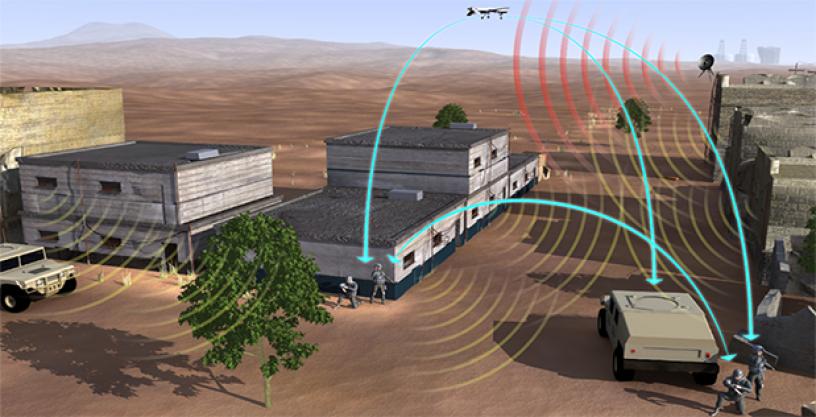
With the help of innovative new chips that can convert analog radar and other electromagnetic signals into processible digital data at unprecedented speeds, warfighters can look forward to enhanced situational awareness in the midst of battle.

Competition for scarce electromagnetic (EM) spectrum is increasing, driven by a growing military and civilian demand for connected devices. As the spectrum becomes more congested, the Department of Defense (DoD) will need better tools for managing the EM environment and for avoiding interference from competing signals. One recent DARPA-funded advance, an exceptionally high-speed analog-to-digital converter (ADC), represents a major step forward. The ADC could help ensure the uninterrupted operation of spectrum-dependent military capabilities, including communications and radar, in contested EM environments. The advance was enabled by 32 nm silicon-on-insulator (SOI) semiconductor technologies available through DARPA’s ongoing partnership with GlobalFoundries, a manufacturer of highly-advanced semiconductor chips.

The EM spectrum, whose component energy waves include trillionth-of-a-meter-wavelength gamma rays to multi-kilometer-wavelength radio waves, is an inherently physical phenomenon. ADCs convert physical data—that is, analog data—on the spectrum into numbers that a digital computer can analyze and manipulate, an important capability for understanding and adapting to dynamic EM environments.

Today’s ADCs, however, only process data within a limited portion of the spectrum at a given time. As a result, they can temporarily overlook critical information about radar, jamming, communications, and other potentially problematic EM signals. DARPA’s Arrays at Commercial Timescales (ACT) program addressed this challenge by supporting the development of an ADC with a processing speed nearly ten times that of commercially available, state-of-the-art alternatives. By leveraging this increased speed, the resulting ADC can analyze data from across a much wider spectrum range, allowing DoD systems to better operate in congested spectrum bands and to more rapidly react to spectrum-based threats.

How fast is fast? The new ADC samples and digitizes spectrum signals at a rate of over 60 billion times per second (60 GigaSamples/sec). That’s fast enough to directly detect and analyze any signal at 30 GHz or below—a range that encompasses the vast majority of operating frequencies of interest. Whereas scanning through these frequencies today requires costly application-specific hardware with long development cycles, the new ADC can provide a “one-stop shop” for processing radar, communications and electronic warfare signals.

Desirable as these blazing sampling speeds are, they also pose challenges. The amount of data generated is staggering, reaching nearly a terabyte per second. This high data rate requires on-chip data-management circuitry that allows signals to be processed locally on the ADC, reducing the amount of data that must be communicated to neighboring electronics. This on-board digital signal processing burns quite a bit of power and also demands state-of-the-art transistors. The 32 nm SOI technology offered by Global Foundries, the only certified DoD supplier of this circuit technology, provided ACT with the leading-edge transistors needed to sample and process the RF spectrum without exceeding power or data-transfer limitations.

Upcoming ACT designs will go further. By using GlobalFoundries’ even more advanced 14 nm technology, ACT’s next generation of ADCs aim to reduce power requirements by an additional 50 percent and enable yet smaller and lighter systems that can sample even greater swaths of the spectrum.

These ongoing improvements in semiconductor-based components highlight the benefit of DARPA’s longstanding commercial partnerships with players who have mastered the upper limits of modern transistor technology, said Troy Olsson, manager of the ACT programs. “Our performers combined innovative designs with advanced fabrication facilities and techniques to create world-class technology,” Olsson said. “And we are already seeing exciting results that closely match our design expectations.”

Image Caption: With the help of innovative new chips that can convert analog radar and other electromagnetic signals into processible digital data at unprecedented speeds, warfighters can look forward to enhanced situational awareness in the midst of battle.

###

Media with inquiries should contact DARPA Public Affairs at outreach@darpa.mil

Tags

| Electronics | EW | Spectrum |


Similarly    Tagged    Content

Microsystems Technology Office Proposers Day
Architecting a New Breed of High Performance Computing for Virtual Training Environments
Microsystems Technology Office to host Office-Wide Proposers Day
New Nanoscale Programmable Switches Promise Faster, More Versatile Chip-scale Devices
Microsystems Technology Office

Images

  • With the help of innovative new chips that can convert analog radar and other electromagnetic signals into processible digital data at unprecedented speeds, warfighters can look forward to enhanced situational awareness in the midst of battle.
    Electromagnetic (EM) Spectrum
Back To Top

  • Print


Selected DARPA Achievements

DARPA collaborated with industry on stealth technology.
DARPA’s Stealth Revolution
In the early days of DARPA’s work on stealth technology, Have Blue, a prototype of what would become the F-117A, first flew successfully in 1977. The success of the F-117A program marked the beginning of the stealth revolution, which has had enormous benefits for national security.
DARPA microelectronics gave rise to today's GPS devices.
Navigation in the Palm of Your Hand
Early GPS receivers were bulky, heavy devices. In 1983, DARPA set out to miniaturize them, leading to a much broader adoption of GPS capability.
First rough conceptual design of the ARPANET.
Paving the Way to the Modern Internet
ARPA research played a central role in launching the Information Revolution. The agency developed and furthered much of the conceptual basis for the ARPANET—prototypical communications network launched nearly half a century ago—and invented the digital protocols that gave birth to the Internet.
  • About Us
  • About DARPA
  • People
  • Offices
  • Innovation Timeline
  • Testimony
  • Budget
  • History list page
  • Image Gallery
  • Our Research
  • Open Catalog
  • News
  • Events
  • Work With Us
  • Opportunities
  • New Program Managers
  • Contract Management
  • For Industry
  • For Small Businesses
  • For Universities
  • For Government and Military
  • Employment at DARPA
  • Site Info
  • Sitemap
  • Cookie Disclaimer
  • Web Policy
  • Privacy Policy
  • Accessibility/Section 508
  • No Fear Act
  • Usage Policy
  • DoD Hotline
  • USA.gov
  • /
  • Freedom of Information Act
  • /
  • Privacy and Civil Liberties
  • /
  • Visitor Information
  • /
  • Contact Us
  • Twitter
  • Facebook
  • YouTube
  • RSS
Defense Advanced Research Projects Agency 675 North Randolph Street
Arlington, VA 22203-2114
703.526.6630

This is an official U.S. Department of Defense website sponsored by the Defense Advanced Research Projects Agency.

You are now leaving the DARPA.mil website that is under the control and management of DARPA. The appearance of hyperlinks does not constitute endorsement by DARPA of non-U.S. Government sites or the information, products, or services contained therein. Although DARPA may or may not use these sites as additional distribution channels for Department of Defense information, it does not exercise editorial control over all of the information that you may find at these locations. Such links are provided consistent with the stated purpose of this website.


After reading this message, click  to continue immediately.

Go Back