Explore by Tag
Explore by Tag
X
  • Access
  • Adaptability
  • Administration
  • Agency
  • AI
  • Air
  • Algorithms
  • Analytics
  • Automation
  • Autonomy
  • Bio-complexity
  • Bio-systems
  • BMC2
  • CBRN
  • Chemistry
  • Communications
  • Complexity
  • Contracts
  • Cost
  • Countermeasures
  • Cyber
  • Data
  • Decentralization
  • Disease
  • Electronics
  • Energy
  • Events
  • EW
  • Finance
  • Forecasting
  • Formal
  • Fundamentals
  • Games
  • Globalization
  • Ground
  • Health
  • History
  • Imagery
  • Injury
  • Integration
  • Interface
  • ISR
  • Language
  • Launch
  • Leadership
  • Logistics
  • Manufacturing
  • Maritime
  • Materials
  • Math
  • Med-Devices
  • Microchips
  • Microstructures
  • Microsystems
  • Mobile
  • Munitions
  • Networking
  • Neuroscience
  • Opportunities
  • Photonics
  • PNT
  • Policy
  • Privacy
  • Processing
  • Programming
  • Quantum
  • Resilience
  • Restoration
  • Robotics
  • Satellites
  • SBIR
  • Security
  • Sensors
  • Space
  • Spectroscopy
  • Spectrum
  • SWAP
  • Syn-Bio
  • Systems
  • Targeting
  • Tech-Foundations
  • Testimony
  • Therapy
  • Thermal
  • Training
  • Transition
  • Trust
  • Unmanned
  • Visualization
Defense Advanced
Research Projects Agency
Main Menu
X
  • About Us
    • About DARPA
    • People
    • Offices
    • Testimony
    • Budget
    • DARPA History
    • Image Gallery
  • /
  • Our Research
  • /
  • News
  • /
  • Events
  • /
  • Work With Us
    • Opportunities
    • Contract Management
    • For Industry
    • For Small Businesses
    • For Universities
    • For Government and Military
    • Employment at DARPA
    • Visitor Information
  • /
  • Search
Main Menu Explore by Tag
Defense Advanced Research Projects AgencyProgram InformationLegged Squad Support System

Legged Squad Support System (LS3)

MAJ Christopher Orlowski, USA, Ph.D.

Legged Squad Support System (LS3)

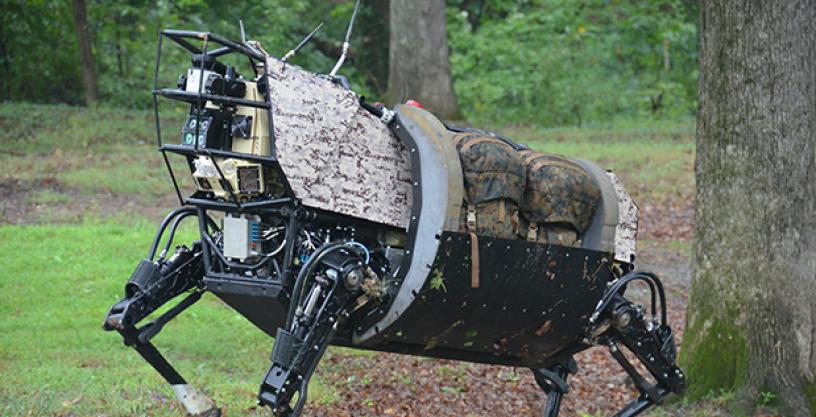
Today’s dismounted warfighter can be saddled with more than 100 pounds of gear, resulting in physical strain, fatigue and degraded performance. Reducing the load on dismounted warfighters has become a major point of emphasis for defense research and development, because the increasing weight of individual equipment has a negative impact on warfighter readiness. The Army has identified physical overburden as one of its top five science and technology challenges. To help alleviate physical weight on troops, DARPA is developing a four-legged robot, the Legged Squad Support System (LS3), to integrate with a squad of Marines or Soldiers.

LS3 seeks to demonstrate that a highly mobile, semi-autonomous legged robot can carry 400 lbs of a squad’s load, follow squad members through rugged terrain and interact with troops in a natural way, similar to a trained animal and its handler.

The LS3 program goal is to develop a robot that will go through the same terrain the squad goes through without hindering the squad’s mission. The robot could also serve as a mobile auxiliary power source to the squad, so troops can recharge batteries for radios and handheld devices while on patrol.

In January 2012, the LS3 prototype completed its first outdoor assessment, demonstrating mobility by climbing and descending a hill and exercising its perception capabilities.

A two-year, platform-refinement test cycle began in July 2012, with Marine and Army involvement, culminating in a planned capstone exercise where LS3 should embed with Marines conducting field exercises. During this period, DARPA seeks to finish the development of and refine LS3’s technologies to provide a suite of autonomy settings, including leader-follower tight, leader-follower corridor and go-to-waypoint, described below:

  • Leader-follower tight: LS3 attempts to follow as close as possible to the path its leader takes
  • Leader-follower corridor: LS3 sticks to the leader but has freedom to make local path decisions, so the leader doesn’t need to think about LS3’s mobility capabilities
  • Go-to-waypoint: LS3 uses its local perception to avoid obstacles on its way to a designated GPS coordinate

Additionally, technologies to allow squad members to speak commands to LS3 are anticipated to be added during this period.

LS3 represents the culmination of a decade of research in perception and autonomy with programs like DARPA’s Unmanned Ground Combat Vehicle-Perception for Off-Road Robotics Integration (UPI) program, mobility work with DARPA’s “Big Dog” and significant advances in natural human-robot interface such as voice recognition.

Tags

| Access | Ground | Logistics | Robotics |


Similarly    Tagged    Content

DARPA Announces VTOL X-Plane Phase 2 Design
Robotic Landing Gear Could Enable Future Helicopters to Take Off and Land Almost Anywhere
Five High School Students Win Robots4Us Video Contest—and a Trip to the DARPA Robotics Challenge Finals
Twenty-five Teams From around the World to Participate in DARPA Robotics Challenge Finals
DARPA Launches Robots4Us Video Contest for High School Students

Images

  • Legged Squad Support System (LS3)
    Legged Squad Support System (LS3)
  • Legged Squad Support System (LS3)
    Legged Squad Support System (LS3)
  • Legged Squad Support System (LS3)
    Legged Squad Support System (LS3)
  • Legged Squad Support System (LS3)
    Legged Squad Support System (LS3)
  • Legged Squad Support System (LS3)
    Legged Squad Support System (LS3)
  • Legged Squad Support System (LS3)
    Legged Squad Support System (LS3)
  • Legged Squad Support System (LS3)
    Legged Squad Support System (LS3)
Back To Top

  • Print


Selected DARPA Achievements

DARPA collaborated with industry on stealth technology.
DARPA’s Stealth Revolution
In the early days of DARPA’s work on stealth technology, Have Blue, a prototype of what would become the F-117A, first flew successfully in 1977. The success of the F-117A program marked the beginning of the stealth revolution, which has had enormous benefits for national security.
DARPA microelectronics gave rise to today's GPS devices.
Navigation in the Palm of Your Hand
Early GPS receivers were bulky, heavy devices. In 1983, DARPA set out to miniaturize them, leading to a much broader adoption of GPS capability.
First rough conceptual design of the ARPANET.
Paving the Way to the Modern Internet
ARPA research played a central role in launching the Information Revolution. The agency developed and furthered much of the conceptual basis for the ARPANET—prototypical communications network launched nearly half a century ago—and invented the digital protocols that gave birth to the Internet.
  • About Us
  • About DARPA
  • People
  • Offices
  • Testimony
  • Budget
  • DARPA History
  • Image Gallery
  • Our Research
  • Open Catalog
  • News
  • Events
  • Work With Us
  • Opportunities
  • Contract Management
  • For Industry
  • For Small Businesses
  • For Universities
  • For Government and Military
  • Employment at DARPA
  • Site Info
  • Sitemap
  • Cookie Disclaimer
  • Web Policy
  • Privacy Policy
  • Accessibility/Section 508
  • No Fear Act
  • Usage Policy
  • USA.gov
  • /
  • Freedom of Information Act
  • /
  • Visitor Information
  • /
  • Contact Us
  • /
  • Alert Registration
  • Twitter
  • Facebook
  • Goolge+
  • YouTube
  • RSS
Defense Advanced Research Projects Agency 675 North Randolph Street
Arlington, VA 22203-2114
703.526.6630

This is an official U.S. Department of Defense website sponsored by the Defense Advanced Research Projects Agency.

You are now leaving the DARPA.mil website that is under the control and management of DARPA. The appearance of hyperlinks does not constitute endorsement by DARPA of non-U.S. Government sites or the information, products, or services contained therein. Although DARPA may or may not use these sites as additional distribution channels for Department of Defense information, it does not exercise editorial control over all of the information that you may find at these locations. Such links are provided consistent with the stated purpose of this website.


After reading this message, click  to continue immediately.

Go Back