Explore by Tag
Explore by Tag
X
  • Access
  • Adaptability
  • Administration
  • Agency
  • AI
  • Air
  • Algorithms
  • Analytics
  • Automation
  • Autonomy
  • Bio-complexity
  • Bio-systems
  • BMC2
  • CBRN
  • Chemistry
  • Communications
  • Complexity
  • Contracts
  • Cost
  • Countermeasures
  • Cyber
  • Data
  • Decentralization
  • Disease
  • Electronics
  • Energy
  • Events
  • EW
  • Finance
  • Forecasting
  • Formal
  • Fundamentals
  • Games
  • Globalization
  • Ground
  • Health
  • History
  • Imagery
  • Injury
  • Integration
  • Interface
  • ISR
  • Language
  • Launch
  • Leadership
  • Logistics
  • Manufacturing
  • Maritime
  • Materials
  • Math
  • Med-Devices
  • Microchips
  • Microstructures
  • Microsystems
  • Mobile
  • Munitions
  • Networking
  • Neuroscience
  • Opportunities
  • Photonics
  • PNT
  • Policy
  • Privacy
  • Processing
  • Programming
  • Quantum
  • Resilience
  • Restoration
  • Robotics
  • Satellites
  • SBIR
  • Security
  • Sensors
  • Space
  • Spectroscopy
  • Spectrum
  • SWAP
  • Syn-Bio
  • Systems
  • Targeting
  • Tech-Foundations
  • Testimony
  • Therapy
  • Thermal
  • Training
  • Transition
  • Trust
  • Unmanned
  • Visualization
Defense Advanced
Research Projects Agency
Main Menu
X
  • About Us
    • About DARPA
    • People
    • Offices
    • Testimony
    • Budget
    • DARPA History
    • Image Gallery
  • /
  • Our Research
  • /
  • News
  • /
  • Events
  • /
  • Work With Us
    • Opportunities
    • Contract Management
    • For Industry
    • For Small Businesses
    • For Universities
    • For Government and Military
    • Employment at DARPA
    • Visitor Information
  • /
  • Search
Main Menu Explore by Tag
Defense Advanced Research Projects AgencyNews And EventsSquad X Core Technologies Seeks to Bring Technological Advances to the Infantry Squad

Squad X Core Technologies Seeks to Bring Technological Advances to the Infantry Squad

New program pursues integrated systems to enhance infantry squad adaptability and flexibility in complex environments 

outreach@darpa.mil
2/9/2015
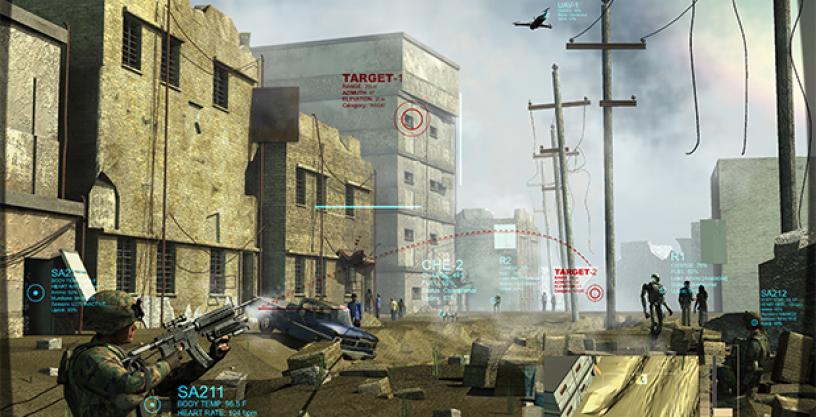
DARPA’s new Squad X Core Technologies (SXCT) program aims to help dismounted infantry squads continue to achieve and maintain overwhelming tactical superiority over potential adversaries. SXCT seeks to adapt, extend and develop capabilities that would enhance small units’ real-time situational awareness and ability to precisely verify and engage hostile targets at multiple ranges. The goal is to speed the development of new, lightweight, integrated systems that provide infantry squads unprecedented awareness, adaptability and flexibility in complex environments, and enable dismounted Soldiers and Marines to more intuitively understand and control their complex mission environments.

Warfighters in aircraft, on ships and in ground vehicles have benefited tremendously from technological advances in recent decades, with advanced capabilities ranging from real-time situational awareness to precision armaments. But many of these benefits depend on equipment with substantial size, weight and power requirements, and so have remained unavailable to dismounted infantry squads who must carry all their equipment themselves.

DARPA’s new Squad X Core Technologies (SXCT) program aims to address this challenge and ensure that dismounted infantry squads maintain uncontested tactical superiority over potential adversaries without being overburdened by cumbersome hardware. The goal is to speed the development of new, lightweight, integrated systems that provide infantry squads unprecedented awareness, adaptability and flexibility in complex environments, and enable dismounted Soldiers and Marines to more intuitively understand and control their complex mission environments.

“SXCT aims to help dismounted infantry squads have deep awareness of what’s around them, detect threats from farther away and, when necessary, engage adversaries more quickly and precisely than ever before,” said Maj. Christopher Orlowski, DARPA program manager. “We are working towards advanced capabilities that would make dismounted infantry squads more adaptable, safe and effective.”

Building off two earlier Requests for Information (see http://go.usa.gov/heS4 and http://go.usa.gov/heSP), SXCT plans to explore four key technical areas:

  • Precision Engagement: Precisely engage threats out to 0.6 mile (1,000 meters), while maintaining compatibility with infantry weapon systems and without imposing weight or operational burdens that would negatively affect mission effectiveness
  • Non-Kinetic Engagement: Disrupt enemy command and control, communications and use of unmanned assets at a squad-relevant operational pace (walking with occasional bursts of speed)
  • Squad Sensing: Detect potential threats out to 0.6 mile (1,000 meters) at a squad-relevant operational pace
  • Squad Autonomy: Increase squad members’ real-time knowledge of their own and teammates’ locations to less than 20 feet (6 meters) in GPS-denied environments through collaboration with embedded unmanned air and ground systems

To familiarize potential participants with the technical objectives of SXCT, DARPA has scheduled a Proposers Day on Friday, February 27, 2015, at DARPA’s offices in Arlington, Va. Advanced registration is required and is available at https://safe.sysplan.com/confsys/squadx. Registration is open and closes Thursday, February 19, 2015, at 5:00 PM Eastern or when capacity is reached, whichever comes first. Due to space limitations of the conference facility, attendance will be limited to the first 150 registrants, and no more than two representatives per organization.

The DARPA Special Notice document announcing the Proposers Day and describing the specific capabilities sought is available at http://go.usa.gov/he8w. For more information, please email DARPA-SN-15-24@darpa.mil.

To maximize the pool of innovative proposal concepts, DARPA strongly encourages participation in these events and subsequent solicitations by non-traditional performers, including small businesses, academic and research institutions and first-time government contractors.

# # #

Associated images posted on www.darpa.mil and video posted at www.youtube.com/darpatv may be reused according to the terms of the DARPA Usage Policy, available here: http://go.usa.gov/nYr.

Tweet @darpa

Tags

| Ground | Networking | Resilience | Sensors |


Similarly    Tagged    Content

Squad X Program Envisions Dismounted Infantry Squads of the Future
Squad X Core Technologies Takes First Steps toward Improving Capabilities for Dismounted Soldiers and Marines
N-ZERO Envisions “Asleep-yet-Aware” Electronics that Could Revolutionize Remote Wireless Sensors
GXV-T Imagines Future Armored Ground Vehicles that Could Increase Survivability through Improved Situational Awareness
GXV-T Envisions Future Armored Ground Vehicles that Could Sprint, Dodge and Shield Their Way Out of Danger

Images

  • Squad X Core Technologies Seeks to Bring Technological Advances to the Infantry Squad
    Squad X Core Technologies Seeks to Bring Technological Advan ...
  • DARPA’s new Squad X Core Technologies (SXCT) program aims to help dismounted infantry squads continue to achieve and maintain overwhelming tactical superiority over potential adversaries. SXCT seeks to adapt, extend and develop capabilities that would enhance small units’ real-time situational awareness and ability to precisely verify and engage hostile targets at multiple ranges. The goal is to speed the development of new, lightweight, integrated systems that provide infantry squads unprecedented awareness, adaptability and flexibility in complex environments, and enable dismounted Soldiers and Marines to more intuitively understand and control their complex mission environments.
    Squad X Core Technologies Seeks to Bring Technological Advan ...
Back To Top

  • Print


Selected DARPA Achievements

DARPA collaborated with industry on stealth technology.
DARPA’s Stealth Revolution
In the early days of DARPA’s work on stealth technology, Have Blue, a prototype of what would become the F-117A, first flew successfully in 1977. The success of the F-117A program marked the beginning of the stealth revolution, which has had enormous benefits for national security.
DARPA microelectronics gave rise to today's GPS devices.
Navigation in the Palm of Your Hand
Early GPS receivers were bulky, heavy devices. In 1983, DARPA set out to miniaturize them, leading to a much broader adoption of GPS capability.
First rough conceptual design of the ARPANET.
Paving the Way to the Modern Internet
ARPA research played a central role in launching the Information Revolution. The agency developed and furthered much of the conceptual basis for the ARPANET—prototypical communications network launched nearly half a century ago—and invented the digital protocols that gave birth to the Internet.
  • About Us
  • About DARPA
  • People
  • Offices
  • Testimony
  • Budget
  • DARPA History
  • Image Gallery
  • Our Research
  • Open Catalog
  • News
  • Events
  • Work With Us
  • Opportunities
  • Contract Management
  • For Industry
  • For Small Businesses
  • For Universities
  • For Government and Military
  • Employment at DARPA
  • Site Info
  • Sitemap
  • Cookie Disclaimer
  • Web Policy
  • Privacy Policy
  • Accessibility/Section 508
  • No Fear Act
  • Usage Policy
  • USA.gov
  • /
  • Freedom of Information Act
  • /
  • Visitor Information
  • /
  • Contact Us
  • /
  • Alert Registration
  • Twitter
  • Facebook
  • Goolge+
  • YouTube
  • RSS
Defense Advanced Research Projects Agency 675 North Randolph Street
Arlington, VA 22203-2114
703.526.6630

This is an official U.S. Department of Defense website sponsored by the Defense Advanced Research Projects Agency.

You are now leaving the DARPA.mil website that is under the control and management of DARPA. The appearance of hyperlinks does not constitute endorsement by DARPA of non-U.S. Government sites or the information, products, or services contained therein. Although DARPA may or may not use these sites as additional distribution channels for Department of Defense information, it does not exercise editorial control over all of the information that you may find at these locations. Such links are provided consistent with the stated purpose of this website.


After reading this message, click  to continue immediately.

Go Back